Falx Cerebri
Question 1. Falx cerebri
Answer:
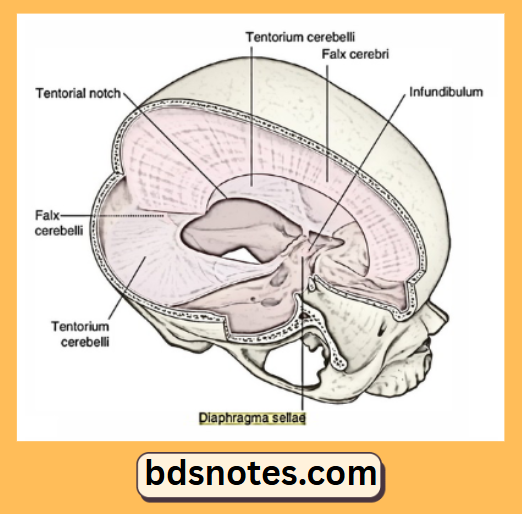
- It is large sickle-shapes fold of duramater
- It occupies the median longitudinal fissure between the two cerebral hemispheres
“Understanding falx cerebri through FAQs: Anatomy, functions, and uses explained”
Ends:
1. Anterior end
- It is narrow & attached to the crista galli
2. Posterior end
- It is broad & attached to the upper surface of the tentorium cerebelli
Falx cerebri anatomy
Margins:
1. Upper convex margin
- Attached to the lips of the sagittal sulcus
“Importance of studying falx cerebri for medical students: Questions explained”
2. Lower concave margin
- It is free
Surfaces:
- Left & right related to the medial surface of the cerebral hemisphere
Location of falx cerebri
Venous sinuses present in it:
- Superior Sagittal sinus
- Inferior Sagittal sinus
- Straight sinus
“Common challenges in mastering falx cerebri notes effectively: FAQs provided”
“Factors influencing success with falx cerebri studies: Q&A”
Question 2. Meckel’s cave
Answer:
- It is a recess of duramater present i.r.t the attached margin of the tentorium
Formed by:
- Evagination of the inferior layer of the tentorium over the trigeminal impression on the petrous temporal bone
Content:
- Trigeminal ganglion
“Steps to explain the anatomy of the falx cerebri: Dural attachment vs meningeal layers: Q&A guide”
Question 12. Emissary vein
Answer:
- These veins connect intracranial venous sinuses with extracranial veins
- They try to relieve raised intracranial pressure
“Role of the falx cerebri in dividing cerebral hemispheres: Questions answered”
Applied anatomy:
- Infection may reach through the emissary veins into cranial venous sinuses
Various emissary veins:
- Parietal emissary vein Mastoid emissary vein Condylar emissary vein
Leave a Reply