Factors Affecting Enzyme Action
Define enzymes. Explain in detail factors affecting enzyme action.
Answer.
Definition Of Enzymes
Enzymes may be defined as biocatalysts synthesized by living cells. They are protein in nature, colloidal, thermo labile in character and specific in action
Factors Affecting Enzyme Action
The factors which affect enzyme action are:
- Temperature
- pH
- Enzyme concentration
- Product concentration
- Substrate concentration
- Coenzymes
- Metal ion activators
- Inhibitors
Effect Of Temperature
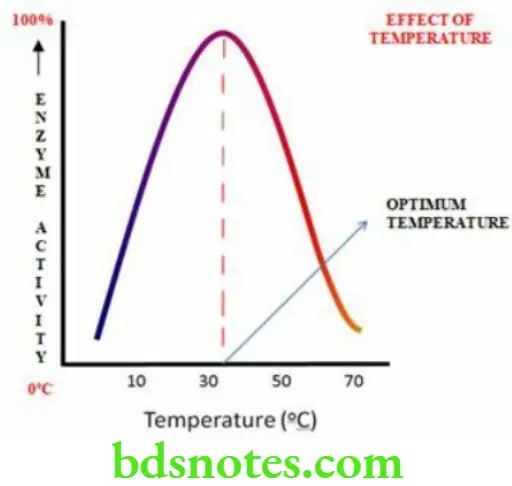
- Each enzyme is most active at a particular temperature known as optimum temperature
- Optimum temperature of most enzymes is in the range of 35 to 40 degrees Celsius
- Reaction velocity almost doubles with 10 degrees Celsius rise in temperature in many enzymes but a very great increase in temperature can cause denaturation of enzyme
- Activity of the enzyme progressively decreases when the temperature of the reaction is below or above the optimum temperature
- It shows a bell shaped curve
Effect Of pH
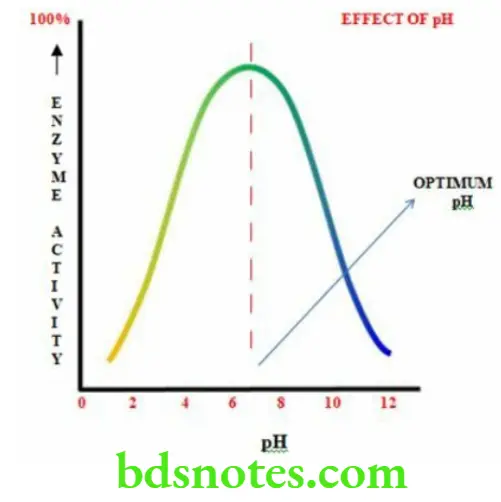
- The enzymatic activity is optimum at a particular pH known as optimum pH
- The optimum pH for most enzymes is in the range of 4 to 9
- At a very low or very high pH the enzyme structure may be destroyed
- It shows a bell shaped curve
Effect Of Enzyme Concentration
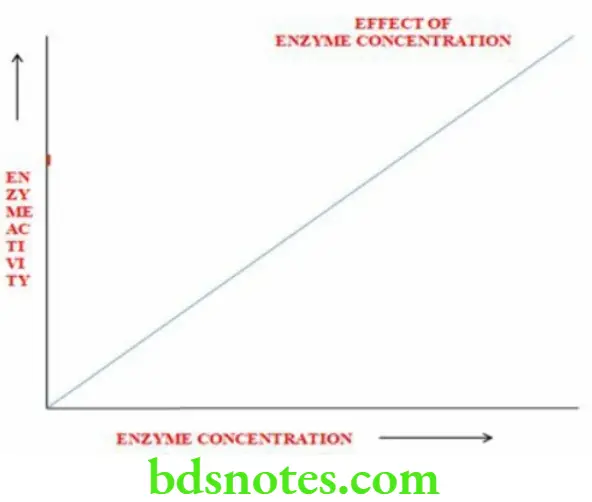
- Velocity of the enzymatic reaction is directly proportional to the enzyme concentration
- Providing more enzyme molecules enables the conversion of progressively larger number of substrate molecules into products
Effect Of Product Concentration
- Products formed as a result of reaction may accumulate and this excess of product may lower the reaction by occupying the active site of the enzyme
- In certain conditions a high concentration of products may cause a reverse reaction forming back the substrate.
Effect Of Substrate Concentration
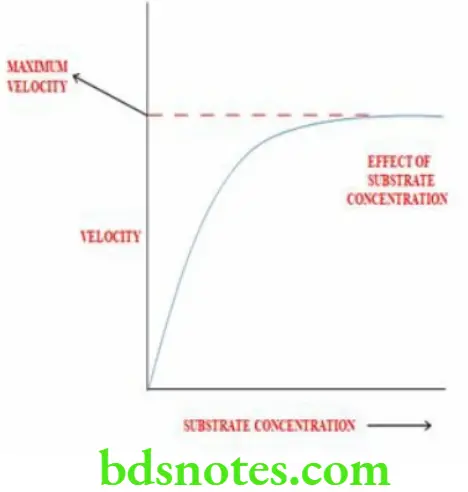
- For a known quantity of enzyme, the reaction is directly proportional to the substrate concentration.
- However this is true only upto a certain concentration after which the increasing concentration of substrate does not further increase the velocity of the reaction
Effect Of Coenzyme
- Some enzymes require non protein, organic, low molecular weight substances known as coenzymes for their action
- These enzymes cannot act in the absence of coenzymes
- Examples –
- TPP is the coenzyme for transketolase enzyme.
- NAD is the coenzyme for lactate dehydrogenase.
Effect Of Metal Ion Activators
- Some enzymes require certain inorganic metallic cations for their optimum activity.
- Examples
- ATPase requires calcium
- Enolase requires magnesium
- Phenol oxidase requires copper
- Pyruvate oxidase requires manganese
- Xanthine oxidase requires molybdenum
- Cytochrome oxidase requires iron
Effect Of Enzyme Inhibitors
- Enzyme inhibitor is defined as a substance which binds with the enzyme and brings about a decrease in the enzyme activity.
- Examples –
- Lactate dehydrogenase is inhibited by oxamate
- HMG COA reductase is inhibited by HMG
- Aconitase is inhibited by transaconitate
- Succinate dehydrogenase is inhibited by malonate.
Leave a Reply