Exocrine Pancreas
Describe exocrine function of pancreas how are they regulated.
Answer:
Pancreas:
- The pancreas is a double function organ containing both exocrine’ as well as `endocrine’ cells.
- The endocrine function involves the production of the hormones.
- The exocrine function involves the secretion of digestive juice pancreatic juice.
- This pancreatic juice is discharged from apices of the cells into the lumen of the pancreatic ducts.
- The pancreatic juice passes via intercalated and excretory ducts to be collected by two ducts: `duct of Wirsung’ and duct of santorini’.
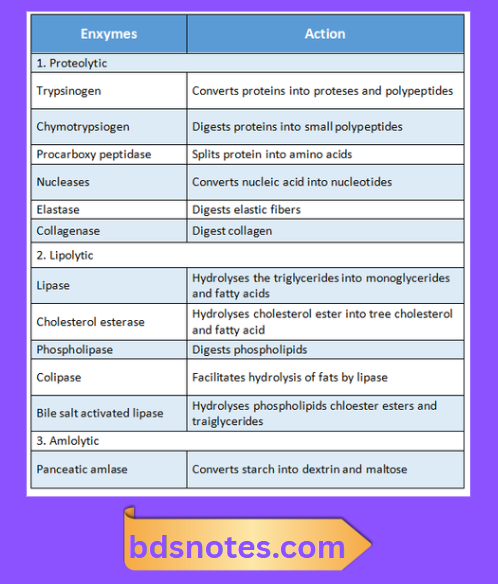
- The cells of the duct contains zymogen granules, which possess digestive enzymes.
“Understanding exocrine pancreas through FAQs: Structure, functions, and uses explained”
“Importance of studying exocrine pancreas for medical students: Questions explained”
Pancreas Regulation:
1. Pancreas Nervous regulation:
- Reflex stimulation of vagus nerve causes increase in pancreatic juice secretion.
- This is seen with.
- Conditioned reflexes,
Example: sight, smell of food. - Unconditioned reflexes.
Example: taste of food.
- Conditioned reflexes,
- The afferent impulses during these reflexes reach the dorsal nucleus of vagus.
- From here, the efferent impulses reach the pancreas via efferent fibers of vagus nerve.
- This results in release of acetylcholine which stimulates the acinar cells of pancreas to release the enzymes.
“Common challenges in mastering exocrine pancreas notes effectively: FAQs provided”
2. Pancreas Humoral regulation:
- GIT hormones on liberation into portal venous blood via systemic circulation reach pancreatic tissue to stimulate the secretion of pancreatic juice.
- They are.
- Secretin:
- Discovered by Bayliss and Starling.
- It is produced by S cells of mucous membrane in duodenum and jejunum.
Action: - Acts on the cells of pancreatic ductules via cyclic AMP.
- It causes secretion of large amount of watery juice with high concentration of bicarbonate ion.
- It also stimulates bile secretion and potentiates the effect of CCK-PZ on the pancreas.
- Cholecystokinin-pancreozymin (CCK – PZ):
- It causes contraction of gall bladder to release bile.
- Causes secretion of pancreatic juice rich in enzymes.
- It also increases the secretion of enterokinase.
- It increases the motility of small and large intestine.
- Secretin:
“Factors influencing success with exocrine pancreas studies: Q&A”
- Gastrin:
- It is produced by the pyloric antrum, duodenum and in some conditions, pancreatic islet tumours.
- It stimulates pancreatic secretion rich in enzymes.
- Vasoactive intestinal polypeptide (VIP):
- It stimulates pancreatic secretion mainly rich in HCO3, water and to some extent enzymes.
- It stimulates intestinal secretion of electrolytes and water.
- Gastrin:
Leave a Reply