• Skip to main content
  • Skip to secondary menu
  • Skip to primary sidebar
  • About Us
  • Terms of Use
  • Privacy Policy
  • Disclaimer
  • Contact Us
  • Sitemap

BDS Notes

BDS notes, Question and Answers

  • Public Health Dentistry
  • Periodontics
  • Pharmacology
  • Pathology
  • Orthodontics
    • Anchorage In Orthodontics
    • Mandibular Growth, Functional Matrix
    • Retention and Relapse
  • General Surgery
    • Cysts: Types, Causes, Symptoms
    • Maxillofacial Fractures, Disorders, and Treatments
    • Lymphatic Disorders
    • Neurological and Facial Disorders
  • Temporal And Infratemporal Regions
    • Spinal and Neuroanatomy
  • Dental Materials
    • Dental Amalgam
Home » Excitation-Contraction Coupling: How Muscles Turn Electrical Signals Into Movement

Excitation-Contraction Coupling: How Muscles Turn Electrical Signals Into Movement

February 6, 2026 by Kristensmith Taylor Leave a Comment

Excitation-Contraction Coupling: How Muscles Turn Electrical Signals Into Movement

Question 1. excitation contraction coupling.
Answer:

Excitation Contraction Coupling Definition:

  • excitation of muscle fiber causes development of action potential which through sequence of events produces muscular contraction.
  • These both are coupled by Ca2+
  • The process by which depolarization of the muscle fiber initiates contraction is called excitation contraction coupling.

Excitation Contraction Coupling  Stages:
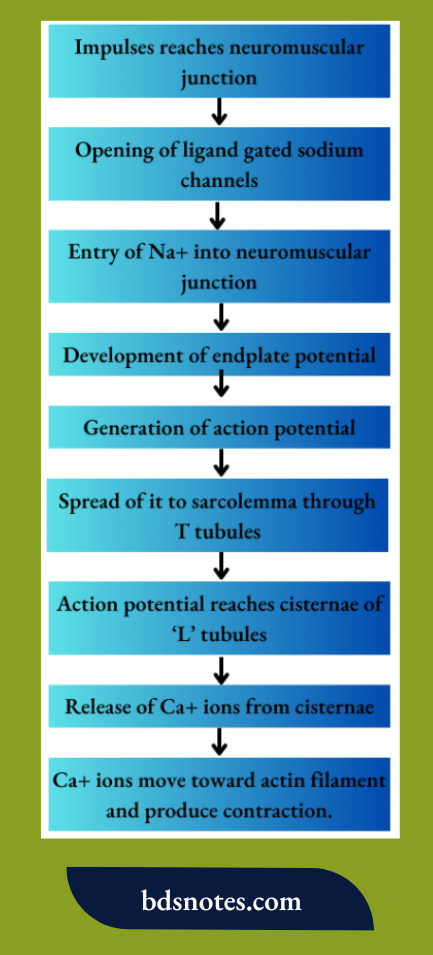
 

Excitation Contraction Coupling  Stages

Question 2. Sliding theory/ratchet/walk along theory.
Answer:

The process by which the shortening of the contractile elements in the muscle is brought about is the sliding of actin filament over the myosin filament.

Events:
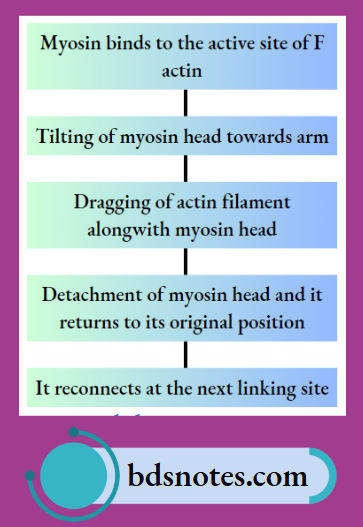
 

Tilting Of Myosin Head Towards Arm

  • Thus, myosin head move back and forth and bring all the actin filament towards the center of sarcomere.
  • This forms actomyosin complex which cause muscular contraction.

Question 3. Myasthenia Gravis.
Answer:

Myasthenia Gravis Definition:

  • It is a neuromuscular diseases characterized by grave weakness of the muscle.

Myasthenia Gravis Cause:

  • It is autoimmune disease
  • Caused due to formation of circulating antibodies against nicotinic acetycholine receptors.

Myasthenia Gravis Symptoms:

  • Muscles mostly involved are: facial extraocular, swallowing and chewing muscles.
  • Rapid onset of fatigue.
  • Slow and weak muscular contraction.
  • Marked generalised weakness of muscles.
  • In severe condition.
    1. Paralysis of muscles.
    2. Death due to paralysis of respiratory muscles.

Filed Under: Anatomy

Reader Interactions

Leave a Reply Cancel reply

Your email address will not be published. Required fields are marked *

Primary Sidebar

Recent Posts

  • Branchial Cleft Cyst: Background, Pathophysiology, Etiology
  • Maxillary Nerve: Origin, Course, And Branches
  • The Father Of Anatomy And A Great Anatomist Herophilus
  • Bone Structure – Anatomy
  • The External Carotid Artery: Anatomy, Branches, And Functions
  • Occipitofrontalis Muscle
  • Superficial Temporal Artery
  • Platysma Muscle
  • Cartilage
  • Cauda Equina And Conus Medullaris Syndromes
  • Subcutaneous Injections And Device Management
  • Types Of Circulation: Pulmonary, Systemic, And Portal
  • Structure Of Skeletal Muscle
  • Elastic Cartilage
  • Cellular Organelles And Structure
  • The Golgi Apparatus – The Cell
  • The Cytoplasmic Inclusions Of Certain Plant Cells
  • Dental Abscess
  • Laser Surgery
  • Our Facial Muscles And Their Functions

Copyright © 2026 · Magazine Pro on Genesis Framework · WordPress · Log in