• Skip to main content
  • Skip to secondary menu
  • Skip to primary sidebar
  • About Us
  • Terms of Use
  • Privacy Policy
  • Disclaimer
  • Contact Us
  • Sitemap

BDS Notes

BDS notes, Question and Answers

  • Public Health Dentistry
  • Periodontics
  • Pharmacology
  • Pathology
  • Orthodontics
    • Anchorage In Orthodontics
    • Mandibular Growth, Functional Matrix
    • Retention and Relapse
  • General Surgery
    • Cysts: Types, Causes, Symptoms
    • Maxillofacial Fractures, Disorders, and Treatments
    • Lymphatic Disorders
    • Neurological and Facial Disorders
  • Temporal And Infratemporal Regions
    • Spinal and Neuroanatomy
  • Dental Materials
    • Dental Amalgam
Home » Excisional New Attachment Procedure (ENAP): Indications, Steps, and Benefits

Excisional New Attachment Procedure (ENAP): Indications, Steps, and Benefits

March 4, 2025 by Kristensmith Taylor Leave a Comment

Excisional New Attachment Procedure


It was developed by US Naval Corps, yukna (1976).

ENAP is a definitive subgingival curettage procedure performed with a knife.

Indications

Suprabony pockets in the presence of convex root surfaces, normal gingival form and width.

“Importance Of Enap For Treating Periodontal Pockets”

Contraindications

  • Soft tissue:
    • Hyperplastic tissues.
    • Inadequate keratinized gingiva.
  • Hard tissue:
    • Furcations
    • Osseous defects.
    • Malposed teeth.
    • Close root approximation.
    • Developmental tooth defects.

“What Is Excisional New Attachment Procedure (Enap)”

Excisional New Attachment Advantages

  • Removal of epithelial pocket lining, junctional attachment and adjacent granulation tissue.
  • Improved visualization and access to the root surfaces.
  • Connective tissue attachment is left intact.
  • Minimal trauma to gingiva.
  • Does not affect the bone.
  • Facilitates new attachment.
  • Minimal postoperative recession.

“Indications For Excisional New Attachment Procedure In Dentistry”

Excisional New Attachment Disadvantages

  • Limited application
  • Technically exacting to determine the apical extent of the epithelial attachment, and epithelial-connective tissue junction.

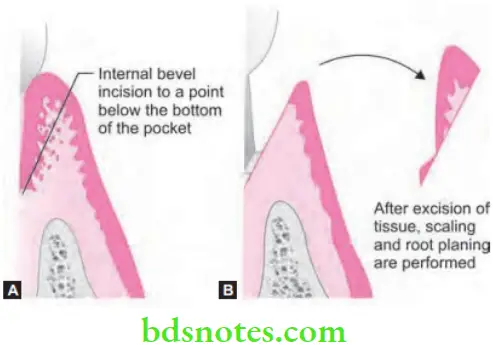
Excisional New Attachment Procedure

  • Deposition of few drops of the anesthetic solution into the lateral wall of pocket will help to reduce bleeding and make the tissue more firm.
  • An internal bevel incision is made from margin of free gingiva apically below the base of the pocket.
  • Incision is carried all around the tooth surface. Care should be taken to retain as much interdental gingiva as possible.
  • Excised tissue is removed with a curette and the root surface is planned to a smooth hard consistency. Pocket is flushed with normal saline.
  • Wound edges are approximated with finger pressure. Interdental sutures and periodontal pack is placed.
  • A long junction epithelium is formed in about 7 days.

“Best Ways To Understand Enap Procedure Steps”
Periodontics Gingival Surgical Techniques Excisional new attachment procedure

Filed Under: Periodontics

Reader Interactions

Leave a Reply Cancel reply

Your email address will not be published. Required fields are marked *

Primary Sidebar

Recent Posts

  • Branchial Cleft Cyst: Background, Pathophysiology, Etiology
  • Maxillary Nerve: Origin, Course, And Branches
  • The Father Of Anatomy And A Great Anatomist Herophilus
  • Bone Structure – Anatomy
  • The External Carotid Artery: Anatomy, Branches, And Functions
  • Occipitofrontalis Muscle
  • Superficial Temporal Artery
  • Platysma Muscle
  • Cartilage
  • Cauda Equina And Conus Medullaris Syndromes
  • Subcutaneous Injections And Device Management
  • Types Of Circulation: Pulmonary, Systemic, And Portal
  • Structure Of Skeletal Muscle
  • Elastic Cartilage
  • Cellular Organelles And Structure
  • The Golgi Apparatus – The Cell
  • The Cytoplasmic Inclusions Of Certain Plant Cells
  • Dental Abscess
  • Laser Surgery
  • Our Facial Muscles And Their Functions

Copyright © 2026 · Magazine Pro on Genesis Framework · WordPress · Log in