Epithelial-Mesenchymal Interaction
Question 1. Epithelial-mesenchymal interaction
Answer:
- Epithelial-mesenchymal interaction governs the development of epidermal organs like teeth
- During the early stages of tooth development, a local ectodermal thickening expressing severe signaling molecules appear
- These signals to the underlying mesenchyme trigger mesenchymal condensation and tooth development
“Factors influencing success with epithelial-mesenchymal interaction studies: Q&A”
Example:
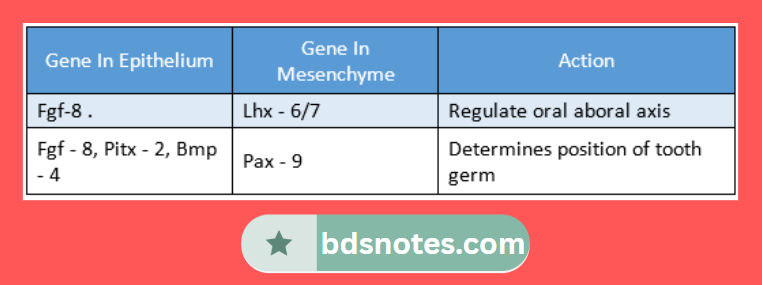
“Understanding epithelial-mesenchymal interaction through FAQs: Mechanisms, functions, and uses explained”
Genes and their action:
- Pax – 9 – determines morphogenesis
- LHX – Mesenchymal marker for initiation
- Fgf – 8 – a marker of the first branchial arch
- Bmp – 2, Bmp – 4 – patterning of tooth
- Bmp – 5 – endochondrogenesis
- Bmp – 7 – dentinogenesis
- Msx 1, Msx 2 – expresses incisor in mandible
- Msx 1, Msx 2 &Dlx – 2 – express canine
- Dlx 2 &Barx 1 – expresses molar
“Importance of studying epithelial-mesenchymal interaction for medical students: Questions explained”
Question 2. Dental lamina.
Answer:
- It results from the dividing of the primary epithelial band at around the 7th week of intrauterine life.
- It represents the lingual process of this band.
- It later breaks to form discrete epithelial islands which are named epithelial pearls.
- It serves as the primordium for the ectodermal portion of the deciduous teeth,
- It has a surface of squamous cells and a basal layer of columnar cells.
“Common challenges in mastering epithelial-mesenchymal interaction notes effectively: FAQs provided”
Leave a Reply