Endodontic Periodontic Relationship
Question 1. Write short note on endoperio lesion.
Answer.
“A periapical lesion originating in pulpal inflammation and necrosis to the oral cavity through periodontal ligament and adjacent alveolar bone.”
“Understanding the link between root canals and gum health”
“Importance of studying endodontic-periodontic connections”
Question 2. Classify endodontic–periodontal lesion.
Answer. Following are the classifications given for endodonticperiodontal lesion:
Classification According to Weine (1982), Based on the Etiology of Disease
- Class 1: Tooth in which symptoms clinically and radiographically simulates periodontal involvement but are in fact due to pulpal inflammation and/or necrosis.
- Class 2: Tooth that has both pulpal and periodontal disease concomitantly.
- Class 3: Tooth that has no pulpal problem but requires endodontic therapy along with root amputation to achieve periodontal healing.
- Class 4: Tooth that clinically and radiologically simulates pulpal or periapical disease but in fact has periodontal disease.
“Common challenges in diagnosing endodontic vs periodontic problems”

Read And Learn More: Periodontics Question And Answers
Classification According to Simon, Glick and Frank (1972), this is the Most Accepted Classification
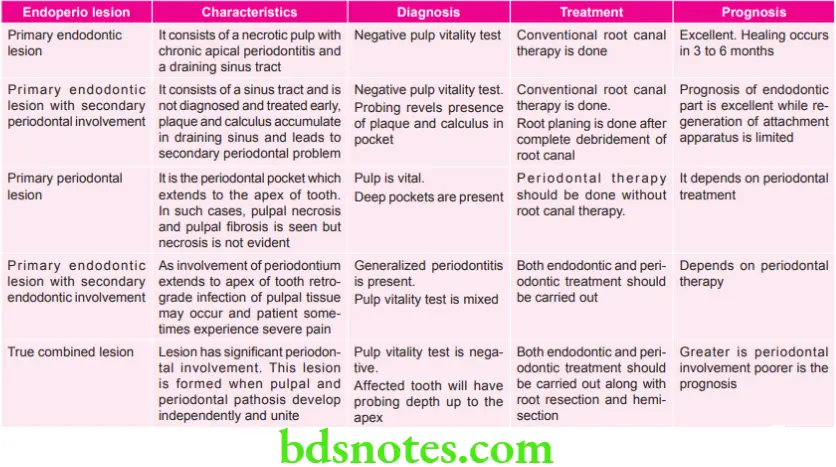
Simon et al. classified endodontic periodontal lesions into five groups based on etiology, diagnosis, prognosis and treatment as follows:
- Primary endodontic lesion
- Primary endodontic with secondary periodontal involvement
- Primary periodontal involvement
- Primary periodontal with secondary endodontic involvement
- True combined lesions
Description of Classification Given by Simon et al
Primary Endodontic Lesions
- Such lesions may be characterized by acute pulpal involvement with drainage of germs via periodontal ligament and gingival sulcus.
- A sinus tract can be evident with varying degree of gingival inflammation.
- Radiographically, there may be no evidence of crestal bone loss. Occasionally, an abscess of pulpal origin may establish drainage through the periodontal ligament and erupt into the furcation or gingival sulcus.
- Patients with the primary endodontic lesion present only diagnostic and treatment decisions related to the endodontic lesions.
Endodontic Periodontal lesion Management
- Appropriate endodontic therapy with debridement of the pulp chamber and canal.
- In certain cases, apical surgery may be required.
- Periodontal therapy if there is periodontal involvement.
“Role of radiographs in differentiating endodontic and periodontic issues”
Primary Endodontic with Secondary Periodontal Involvement
- Progression of primary endodontic lesion into deeper aspects of periodontium causes pocket formation and bone loss, this may be evident in radiographs.
- Pulp vitality tests may be negative.
Primary Endodontic with Secondary Periodontal Involvement Management
- Proper endodontic therapy.
- Periodontal pocket eradication procedures.
Primary Periodontal Lesion
- There is presence of deep pocket which extends to the apical foramen or to the opening of an accessory canal, is an indicative of this type of lesion.
- Radiographic evidence of bone loss is common, In some of the cases, spread of infection from the periodontal aspect to pulp may occur which causes fibrosis and calcification inside the pulp. Pulp here responds to the vitality tests.
Primary Periodontal Lesion Management
- Proper periodontal therapy is given to the patient which includes pocket eradication procedures.
- Endodontic therapy may not be necessary.
“Biomechanics of pulp necrosis affecting periodontal ligament explained”
Primary Periodontal with Secondary Pulpal Involvement
- Extension of a primary periodontal lesion into the pulp leads to pulpal necrosis or pulpitis.
- An existing periodontal lesion may extend apically to apical foramen, causing secondary pulpal infection. This is referred to as ‘retrograde pulpitis’. Such cases usually present with severe periodontitis with subsequent clinical manifestations of pulpitis.
Primary Periodontal with Secondary Pulpal Involvement Management
- Provide appropriate periodontal therapy
- Provide proper endodontic therapy
“Steps to treat endodontic-periodontic lesions effectively”
True Combined Lesions
- A true combined lesion occurs from the development and extension of an endodontic lesion into an existing periodontal lesion.
- Pain from the loss of pulpal vitality is a most common presenting complaint of such patients and basically they present with features of both the diseases.
- Most often a developing periapical lesion extends coronally to connect with a pre-existing, chronic wide based periodontal pocket.
- Pulp vitality tests may be related to the status of pulpal involvement, and radiographic evidence of bone loss may be observed.
True Combined Lesions Management
- Provide appropriate periodontal therapy
- Provide proper endodontic therapy
“Comparison of endodontic abscess vs periodontal abscess”
Classification According to Torabinejad and Trope (1996), this is Based on Periodontal Pocket Origin
- Endodontic origin
- Periodontal origin
- Combined endo–perio lesion
- Separate endodontic and periodontal lesions
- Lesions with communication
- Lesions with no communication
Classification According to World Workshop for Classification of Periodontal Diseases (1999)
- Endodontic-periodontal lesion
- Periodontal-endodontic lesion
- Combined lesion
Leave a Reply