Endochondral Ossification: Step-By-Step Microscopic Changes
Question 1. Microscopic picture of endochondrial ossification
Answer:
- Following changes occurs during endochondrial ossification
- Mesenchymal cells are closely packed to form Mesenchymal condensation
- Some of them differentiate into chondrocytes & lay down hyaline cartilage
- Cells of this cartilage are
- Initially-small & irregular
- Later-Enlarges
- Next, due to lack of nutrition, cells die forming empty spaces called primary areolae
- This is later destroyed by the blood vessels of perichondrium & results in secondary areolae
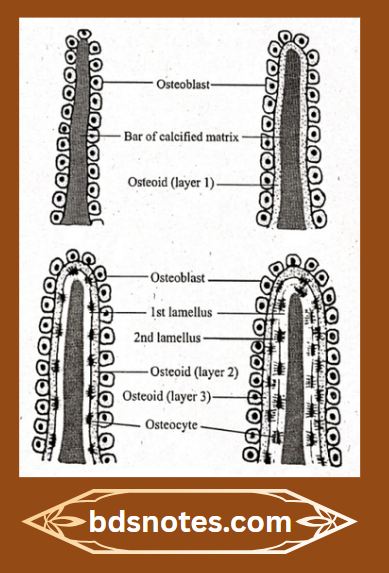
- Osteoprogenitor cell invade it & becomes osteoblasts
- Osteoblasts lay down a layer of osteoid
- Osteoid is calcified & forms lamellus of bone
- Similarly, osteoblasts lay down another layer of lamellus which gets calcified
- Some osteoblasts are entrapped between the two lamellae & becomes osteocytes Osteocyte
Question 2. Histology of skeletal muscle
Answer:
- The muscle present in relation to bony skeleton is called skeletal muscle
- Histology of skeletal muscle It is made up of:
- Muscle fibres
- They are long and cylindrical
- They are arranged in bundles called fasciculi
- Each muscle fibre is covered by a plasma membrane called sarcolemma
- Connective tissue
- It supports and unites muscle fibres
- Muscle fibres
Histology of skeletal muscle Striations:
- Skeletal muscle section on staining shows alternate dark and light band
- A band dark band
- I band-light band
- Z band-dark line between I band
- H band-light line between A band
- M band dark line in center of H band
- Part present between two consecutive Z bands is called sarcomere.
Leave a Reply