Drug Interaction Between Propranolol And Verapamil
Question 1. Explain Why Selective Α1 Agonists Are Preferred Over NonSelective Α Blockers For Hypertension.
Answer:
Selective α1 blockers block selectively α1 vascular receptors by a competitive mechanism. They have no effect on α2 receptors so there is not any increase in the levels of noradrenaline due to which there is very less tachycardia while the non-selective α blockers block both α1 and α2 receptors.
So due to their blocking effect of α2 receptors, there is an increase in the release of noradrenaline due to which tachycardia is more. That’s why selective α1 agonists are preferred over non-selective α blockers in hypertension.
Question 2. Write Short Note On Sodium Nitroprusside In Hypertensive Emergencies.
Answer:
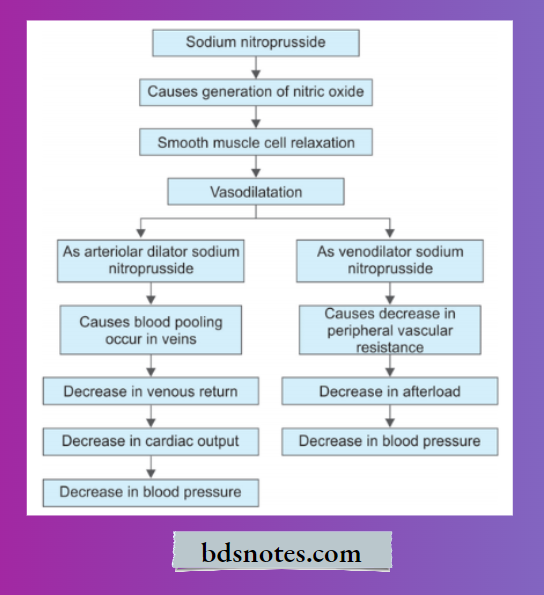
Sodium nitroprusside is a powerful parenterally administered vasodilator that dilates both venous and arterial blood vessels resulting in a decrease in peripheral vascular resistance and in venous return.
The onset of its hypotensive effect is rapid. It is administered by continuous IV infusion for the treatment of hypertensive emergencies.
Question 3. Explain The Drug Interaction Between Propranolol And Verapamil.
Answer:
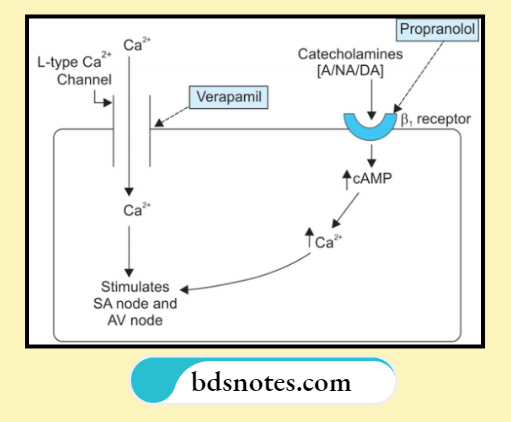
Propranolol along with verapamil cause additive depression of the SA node and AV conduction and can lead to cardiac arrest.
Verapamil is a phenylethylamine calcium channel blocker that has maximal cardiac depressant activity among all calcium channel blockers. It reduces the calcium influx in SA Node and AV node thereby reducing their automaticity. Propranolol also has a depressant effect in the SA Node and AV node.
So, if both drugs are administered concomitantly, they exhibit additive depression of sinus rhythm and cardiac conduction. This may result in severe bradycardia to the extent of even asystole. This may prove fatal for the individual receiving this combination of drugs.
Leave a Reply