• Skip to main content
  • Skip to secondary menu
  • Skip to primary sidebar
  • About Us
  • Terms of Use
  • Privacy Policy
  • Disclaimer
  • Contact Us
  • Sitemap

BDS Notes

BDS notes, Question and Answers

  • Public Health Dentistry
  • Periodontics
  • Pharmacology
  • Pathology
  • Orthodontics
    • Anchorage In Orthodontics
    • Mandibular Growth, Functional Matrix
    • Retention and Relapse
  • General Surgery
    • Cysts: Types, Causes, Symptoms
    • Maxillofacial Fractures, Disorders, and Treatments
    • Lymphatic Disorders
    • Neurological and Facial Disorders
  • Temporal And Infratemporal Regions
    • Spinal and Neuroanatomy
  • Dental Materials
    • Dental Amalgam
Home » Differences Between Necrosis And Gangrene

Differences Between Necrosis And Gangrene

November 28, 2025 by Kristensmith Taylor Leave a Comment

Differences Between Necrosis And Gangrene

Question 1. Classify Necrosis. Give Differences Between Necrosis And Gangrene.
Answer:

Classification of Necrosis

  • Coagulative Necrosis
  • Liquefaction Necrosis
  • Caseous Necrosis
  • Fat Necrosis
  • Fibrinoid Necrosis.

Difference between necrosis and gangrene

Differences Between Necrosis And Gangrene
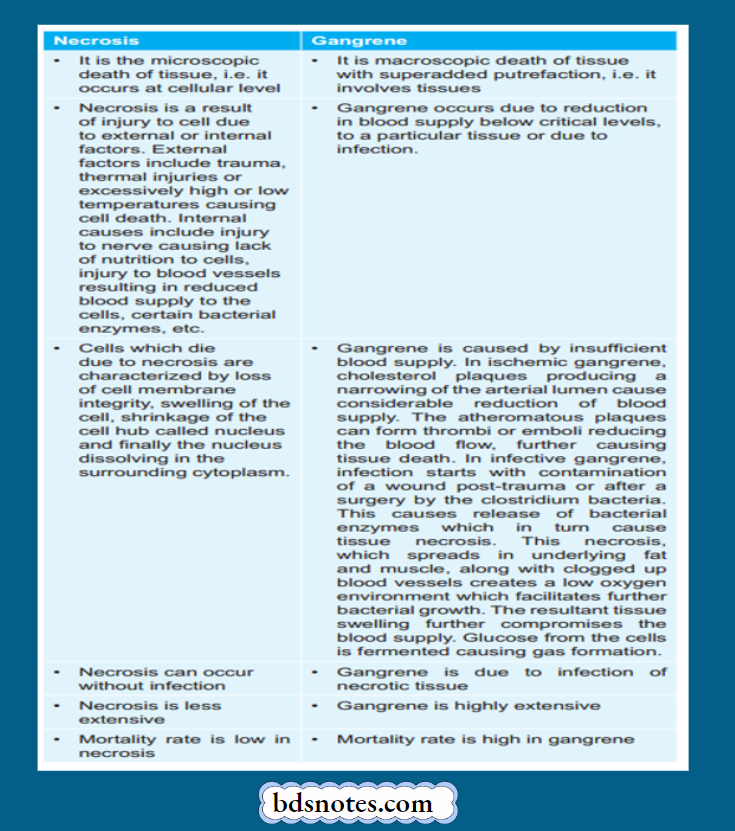
Necrosis vs Gangrene Key Differences

Question 2. Define Necrosis And Enumerate The Causes Of Necrosis. Write The  Pathogenesis Of Caseous Necrosis.
Answer:

Necrosis is defined as focal death along with the degradation of tissue by hydrolytic enzymes liberated by cells.

Causes Of Necrosis

  • Hypoxia
  • Physical agents: Physical agents include mechanical trauma, extremes of temperature (burns and deep cold), sudden changes in atmospheric pressure, radiation, and electric shock.
  • Chemicals and drugs: Trace amounts of agents known as poisons, such as arsenic, cyanide, or mercuric salts, may destroy sufficient numbers of cells within minutes to hours to cause death.
  • Microbial agents: Injuries by microbes include infections caused by bacteria, rickettsiae, viruses, fungi, protozoa, metazoa, and other parasites.
  • Immunologic agents: Hypersensitivity reactions, anaphylactic reactions, and autoimmune diseases.

Types of necrosis and gangrene

Pathogenesis Of Caseous Necrosis

Caseous necrosis is seen in tuberculosis. The development of caseous necrosis is possibly due to the interaction of mycobacteria with activated T cells as well as by the direct toxicity of mycobacteria on macrophages.

Filed Under: Pathology

Reader Interactions

Leave a Reply Cancel reply

Your email address will not be published. Required fields are marked *

Primary Sidebar

Recent Posts

  • Branchial Cleft Cyst: Background, Pathophysiology, Etiology
  • Maxillary Nerve: Origin, Course, And Branches
  • The Father Of Anatomy And A Great Anatomist Herophilus
  • Bone Structure – Anatomy
  • The External Carotid Artery: Anatomy, Branches, And Functions
  • Occipitofrontalis Muscle
  • Superficial Temporal Artery
  • Platysma Muscle
  • Cartilage
  • Cauda Equina And Conus Medullaris Syndromes
  • Subcutaneous Injections And Device Management
  • Types Of Circulation: Pulmonary, Systemic, And Portal
  • Structure Of Skeletal Muscle
  • Elastic Cartilage
  • Cellular Organelles And Structure
  • The Golgi Apparatus – The Cell
  • The Cytoplasmic Inclusions Of Certain Plant Cells
  • Dental Abscess
  • Laser Surgery
  • Our Facial Muscles And Their Functions

Copyright © 2026 · Magazine Pro on Genesis Framework · WordPress · Log in