Diarrheal Diseases
Question 1. Write a note on septicemia.
Answer:
Septicemia is defined as a condition in which bacteria circulate and actively multiply in the bloodstream.
“Asymptomatic vs symptomatic effects of ignoring diarrheal disease principles: Q&A”
Organisms Leading to Septicemia
- Gram-negative Bacilli:
- Salmonella typhi
- S. paratyphi A, B, C
- Brucella sp.
- Haemophilus influenza
- E. coli
- Klebsiella pneumoniae
- Proteus spp.
- Bacteroides spp.
- Pseudomonas spp.
- Gram-positive Cocci:
- S. aureus
- Staphylococcus epidermidis
- S. pyogenes
- Streptococcus pneumoniae.
- Gram-positive Bacilli:
- Listeria monocytogenes.
- Gram-negative Cocci:
- Neisseria meningitidis.
“Understanding diarrheal diseases through FAQs: Q&A explained”
Septicemia is accompanied by systemic effects like toxemia, multiple hemorrhages, neutrophilic leukocytosis, and disseminated intravascular coagulation
Read And Learn More: Microbiology Question And Answers
Question 2. Write briefly on causative organisms of food poisoning.
Or
Write notes on causative organisms of food poisoning.
Answer:
The following are the causative organisms of food poisoning:
- Infective type:
- Salmonella sp.
- Vibrio parahemolyticus
- Campylobacter jejuni.
- Toxic type:
- Staphylococcus aureus
- Bacillus cereus
- Clostridium botulinum.
- Intermediate type:
- Clostridium perfringens.
“Importance of studying diarrheal diseases for public health students: Questions explained”
1. Infective Type: Infective doses of microorganisms are ingested along with the food. Bacteria multiply inside the body. An example is Salmonella.
- Salmonella:
- Food poisoning by Salmonella occurs by consuming the infected animal product.
- Salmonella typhimurium is the most common species to cause food poisoning.
- Salmonella enters through the shell of the egg and grows inside. This occurs when eggs are left on contaminated chicken feed or feces.
- Salmonella is isolated from the feces and food.
- Vibrio parahemolyticus:
- It is a causative agent of food poisoning due to the consumption of seafood.
- It is isolated from shellfish, shrimps, crabs, and mollusks.
- It is killed by heat at 60 °C in 15 minutes.
- It does not grow at 40°C but can survive freezing.
- Drying destroys the bacteria.
- Strains of Vibrio isolated from humans are hemolytic and are known as the Kanagawa phenomenon.
- Kanagawa-positive strains are pathogenic for humans.
- Campylobacter jejuni:
- It is an important human pathogen that leads to food poisoning.
- Ingestion of raw milk, contaminated water, and partially cooked poultry food leads to infection.
- C. jejuni produces heat labile enterotoxin. C. jejuni penetrates gut epithelium and produces a heat-labile enterotoxin and cytotoxic, which leads to damage.
“Common challenges in understanding diarrheal diseases effectively: FAQs provided”
2. Toxic Type: In this preformed bacterial toxin is ingested with food, e.g. staphylococcal food poisoning
- Staphylococcus aureus: Staphylococcal food poisoning may follow 2 to 6 hours after the ingestion of contaminated food.
- Bacillus cereus:
- Bacillus cereus is distributed in nature such as soil, vegetable, cereal, spices, milk, and meat.
- At times some spores survive cooking and germinate into vegetative bacilli which secrete endotoxin and leads to food poisoning.
- It leads to two types of food poisoning, i.e. a. Short incubation period type: Presence of nausea and vomiting, i.e. 1 to 5 hours after the meal.
- Associated with consumption of cooked rice. B. cereus is present in
large numbers in cooked rice and in fecal samples of infected patients. - Long incubation period type: Presence of acute abdominal
pain and diarrhea, i.e. 8 to 16 hours after meal. The fecal sample contains a small number of Bacillus cereuses.
“Early warning signs of gaps in understanding diarrheal disease basics: Common questions”
- Clostridium botulinum:
- It leads to a severe form of food poisoning known as botulism.
- It is found in soil, animal manure, sea mud, and vegetables. Botulism is of three types, i.e.
- Foodborne Botulism: It occurs due to preformed toxin in food contaminated with Clostridium botulinum. The source is preserved food, i.e. meat, fish, and vegetables. Contaminated food exhibits signs of spillage, cans may be inflated and show bubbles on opening. Symptoms that appear are vomiting, thirst, ocular paralysis, dysphagia, and dyspnea. Death occurs due to respiratory failure.
- Infant Botulism: It occurs due to the ingestion of food contaminated by spores of Clostridium botulinum. Honey is the source of infection. The patient has symptoms of constipation, weakness, lethargy, and cranial palsy. Spores and toxins are excreted in the feces of the patient.
- Wound Botulism: Toxin produced by Cl. botulinum is absorbed in blood and symptoms similar to foodborne botulism occur.
3. Intermediate Type: Bacteria ingested with food release the toxin in the gut. Example of Clostridium Perfringens.
- Clostridium Perfringens:
- Some strains of Type A Cl. Perfringens cause food poisoning. These strains secrete alpha-toxin.
- The incubation period is from 8 to 12 hours.
- Heat labile enterotoxin is liberated in the small intestine after ingestion of contaminated cooked meat and poultry food.
“Factors influencing success with diarrheal disease knowledge: Q&A”
Question 3. Write a short note on food poisoning.
Answer:
Food poisoning can be defined as any type of illness acquired through the consumption of food or drink that is contaminated with microorganisms, toxins, and chemical poisons.
Classification of Food Poisoning:
- Based on the mechanism of infection:
- The flowchart is given below
“Steps to incorporate AI into analyzing diarrheal disease outbreaks: Questions and answers”
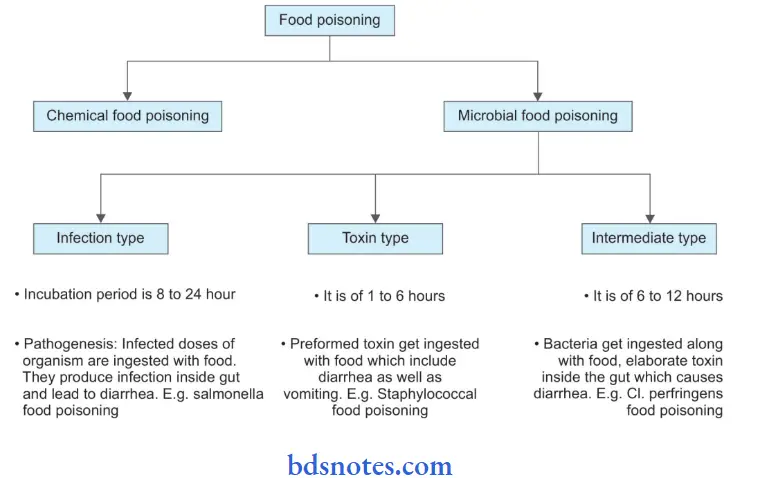
“Steps to explain types of diarrheal diseases: Viral vs bacterial vs parasitic causes: Q&A guide”
Based on causative agents:
- Gram-positive cocci
- Gram-positive spore-forming bacilli
- Gram-negative bacilli
Pathogenesis of Food Poisoning
- Various sources of infection are meat, poultry, fish, eggs, salad, milk, milk products, etc.
- Infection occurs due to ingestion of contaminated food due to bacteria or toxins. Mechanisms are:
- Preformed toxins get ingested in the food and organisms such as S. aureus and B. cereus form toxins inside the food. Ingestion of such food leads to diarrhea and vomiting.
- Microorganisms that invade gastrointestinal organisms such as Salmonella species, Campylobacter jejuni, Vibrio parahemolyticus, and V. mimicus are ingested with food. These microorganisms invade the gastrointestinal tract and produce diarrhea.
- Organisms, i.e. Cl. perfringens, enteropathogenic E. coli, and Cl. botulinum get ingested with the food and produce toxins inside the gut which leads to diarrhea.
“Role of dehydration in diarrheal disease complications: Questions answered”
Clinical Features of Food Poisoning
- Nausea and vomiting
- Pain in abdomen
- Diarrhea
- Fever with rigor
- Muscular weakness
- Drowsiness and restlessness
Laboratory Diagnosis
- Specimen: Food, vomitus, feces, and blood are used as specimens.
- Demonstration of Toxin: Toxin can be demonstrated in specimens by toxin-antitoxin neutralization tests in mice.
- Demonstration of Microorganisms: Smears made from suspected food, as well as feces, are examined by Gram staining. Gram-positive sporing bacilli can be seen. Culture can be done on blood agar or cooked meat media under anaerobic conditions. Detection of toxin in culture fluid is done by toxigenicity test in mic
Leave a Reply