Dental Casting Investment Material
An investment can be described as a ceramic material, which is suitable for forming a mold into which molten metal or alloy is cast. The procedure for forming the mold is described as “investing”.
Materials such as gypsum, phosphate, and silicate are used for investment as they can withstand higher temperatures of burnout and casting procedures. Investment material is available as a two-component system as powder and liquid, to be mixed before investing wax pattern.
“Best Ways To Understand Dental Investment Material Types”
Ideal Requirements for Dental Investment Material
- The investment mold must expand to compensate for the alloy shrinkage that occurs during the cooling of the molten alloy.
- The powder should have a fine particle size to give a smooth surface to the casting.
- The manipulation should be easy. It should have a suitable setting time.
- The material should have a smooth consistency when mixed.
- The set material should be porous enough to permit air in the mold cavity to escape easily during casting.
Types Of Dental Investment Materials
- At higher temperatures, the investment must not decompose to give off gases that may corrode the surface of the alloy.
- It must have adequate strength at room temperature to permit handling and enough strength at higher temperatures to withstand the impact force of the molten metal.
- Casting temperature should not be critical.
- After casting, it should break away readily from the surface of the metal and should not react chemically with it.
- The material should be economical.
“Importance Of Dental Casting Investments In Prosthodontics”
Composition of Investments Material
All investment materials must contain a refractory and a binder.
Refractory: A material that will withstand high temperatures without decomposing or disintegrating, for example, Silica.
Silica exists in at least four allotropic forms:
- Quart
- Tridymite
- Crystabolite
- Fused quartz
They serve two functions:
- Act as a material that can withstand high temperatures.
- Regulates the thermal expansion.
Composition Of Dental Investment Materials
Binder: A material that will set, and bind together the particles of refractory substances, for example, Gypsum, Phosphate, and Silicate.
Other chemicals: Other chemicals such as sodium chloride, boric acid, graphite, and copper are added in small quantities to modify the physical properties.
“Risk Factors For Failure In Dental Casting Investment Materials”
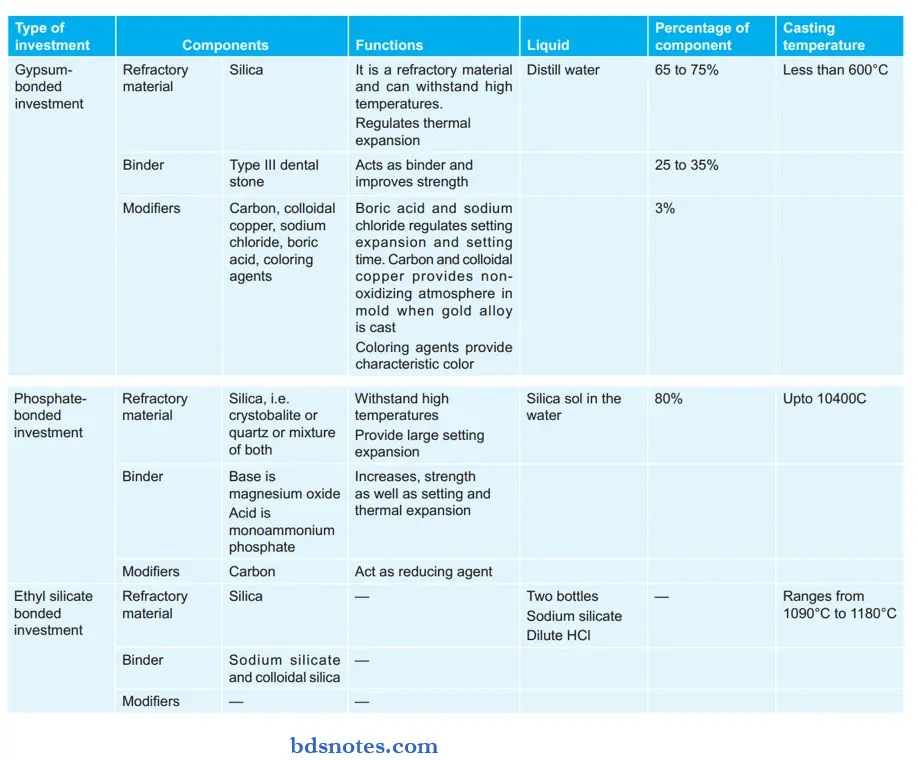
Types/Classification of Investment Materials
1. Based on the Type of Binder Used: There are three types of investment materials. Based on the type of binder all contain silica as refractory material.
- Gypsum-bonded investment: A common type of binder used is alpha hemihydrate.
- Uses: For the casting of ‘inlays, bridges and removable partial denture framework using gold alloys and another low fusing alloy’.
“Understanding The Role Of Dental Casting Investments In Modern Dentistry”
- Phosphate-bonded investment: Ammonium diacid phosphate is used as a binder.
- Uses: For casting high-fusing alloys.
- For example High fusing noble metal alloys, metal-ceramic alloys, and base metal alloys like nickel-chromium and cobalt chromium.
Applications Of Dental Investment Materials
- Silica-bonded investments: The silica is the binder. It is derived from ethyl silicate or aqueous dispersion of colloidal silica or sodium silicate.
- They are the alternatives to phosphate-bonded investments for high-temperature casting. They are primarily used in the casting of base metal alloy partial dentures.
“Early Signs Of Problems With Dental Investment Materials”
2. Based on Application:
- Type 1: For the construction of inlays, crowns, and other fixed restorations.
- Type 2: For construction of complete or partial dentures or other removable partial appliances.
Dental Investment Material Uses
- Type 3: For construction of casts using brazing procedures.
- Type 4: For construction of refractory dies.
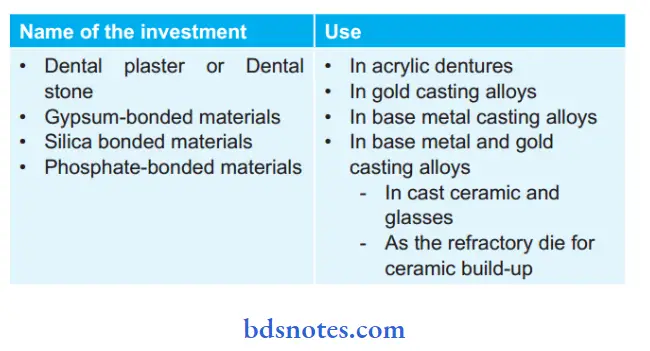
Applications of Investment Materials:
Leave a Reply