Dental Amalgam
Question 1. Classify tooth-filling materials. Describe the composition and role of each ingredient of silver amalgam alloy.
Answer:
Restorative materials: A restorative material is a material that substitutes the missing tooth structure and restores the form and function of the tooth.
Dental Filling Materials Classification
Classification of Tooth Filling Materials/Tooth Restorative Materials
1. According to the Nature of Materials:
- Metallic: Dental amalgam, direct filing gold, miracle mix, casting gold, and base metal alloys.
- Non-metallic: Dental cement, composites, and ceramics.
“Understanding tooth-filling materials through FAQs: Classification, composition, and applications explained”

“How do tooth-filling materials enhance restorative dentistry? FAQ answered”
Read And Learn More: Dental Materials Question And Answers
2. According to Life Span:
- Permanent restorative materials: Dental amalgam, direct filing gold, miracle mix, casting gold and base metal alloys, composites, ceramics, and modified glass ionomer cement.
- Semipermanent/intermediate: Life span is weeks to months. Modified zinc oxide eugenol cement, zinc phosphate cement, and zinc polycarboxylate cement.
- Temporary: Life span is days to weeks. Acrylic resins, zinc oxide eugenol cement.
3. According to Placement:
- Anterior restorations: Glass ionomer cement, silicate cement, composites, and ceramics.
- Posterior restorations: Dental amalgam, posterior composites, metal-modified glass ionomer cement, base metal alloys, and metal—ceramics.
Types Of Dental Amalgam
4. According to the Technique:
- Direct restorations: Dental cement, dental amalgam, direct filing gold, composites.
- Indirect restorations: Ceramics, casting gold, and base metal alloys.
“Importance of studying tooth-filling materials for dental professionals: Questions explained”
5. According to Hardening:
- Acid-base reactions: Dental cement except for resin cement.
- Polymerization: Composites, resin cement, compomers.
- Solidification: Casting gold and base metal alloys, and ceramics.
Composition of Silver Amalgam Alloy:
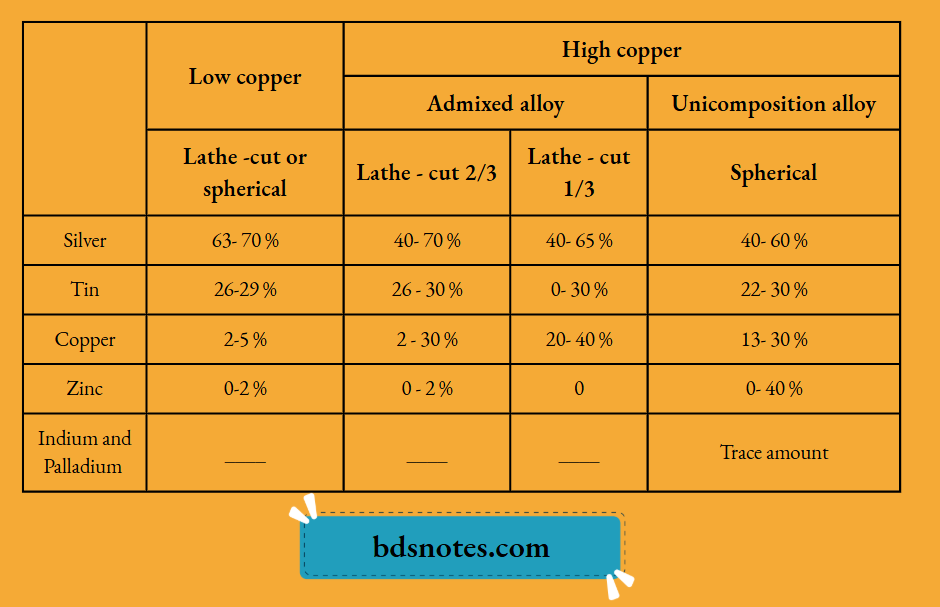
“Common challenges in mastering tooth-filling material classification effectively: FAQs provided”
Types Of Dental Fillings
Role of Each Ingredient of Silver Amalgam Alloy Silver
Silver:
- A major element in the reaction
- Whitens the alloys
- Decreases the creep
- Increases the strength
- Increases the expansion of the setting
- Increases the tarnish resistance
Tin:
- Tin controls the reaction between silver and mercury
- Reduces the strength and hardness
- Reduces the resistance to tarnish and corrosion.
“Factors influencing success with tooth-filling material knowledge: Q&A”
Copper:
- Increases the hardness and strength.
- Increases the setting expansion.
Zinc:
- Zinc acts as “a scavenger or “deoxidizer” during manufacture thus preventing the oxidation of important elements like silver, tin, or copper.
- Zinc causes “delayed expansion” if the amalgam mix is contaminated with moisture during manipulation.
“Steps to explain tooth-filling material classification: Amalgam vs composite vs glass ionomer vs ceramics: Q&A guide”
Mercury: Mercury reacts with other metals to form a plastic mass which is conveniently packed into a prepared cavity.
Dental Restorative Materials
Platinum: Hardens the alloy and increases resistance to corrosion.
Palladium: Hardens and whitens the alloy.
Indium: Indium when added to mercury reduces mercury vapor and improves wetting. It increases the field strength and reduces creep.
Leave a Reply