Dental Alloys: Types, Properties, Applications
Peritectic Alloy:
- Peritectic alloys are alloys involving phase reaction and transformation upon solidification because of the partial solubility of constituent metals.
- Like the eutectic transformation, the peritectic reaction is an invariant reaction that occurs at a particular composition and temperature.
- In peritectic transformation, a liquid and solid phase of fixed proportion reacts at a fixed temperature to yield a single solid phase.
- Peritectic reaction during the cooling phase can be written as:
- Liquid + β solid solution ––––––→ α solid solution
- They are susceptible to coring during rapid cooling. The cored structure is more brittle and has less corrosion resistance than a homogenous solid solution.
“Best Ways To Understand Dental Alloy Types”
Peritectic Alloys In Dentistry
Examples of Peritectic Alloy:
- The Ag-Sn system which is the basis for the original dental amalgam alloys is a peritectic system.
- A peritectic phase transformation also occurs in the Ag- Pt system which is associated with many gold-casting alloys.
- Also, the Pd -Ru alloy system has a peritectic reaction at 16.5%. Ruthenium (Ru) is an important grain refining element for palladium casting alloys.
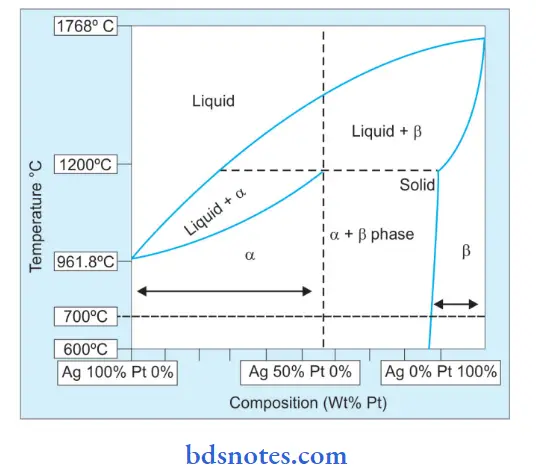
Phase Diagram of Silver—Platinum Alloy System for Peritectic Alloy:
As per the phase diagram, there is silver—a rich α phase and platinum-rich β phase with limited solid solubility in between.
The limited solubility of silver in platinum is less than approximately 12% at 700 °C while the equilibrium solid solubility of platinum in silver is approximately 56% at 700 °C. Peritectic transformation occurs at a point where the solid solution, i.e. composition at β and platinum β phase transforms in silver rich α phase.
“Importance Of Dental Alloys In Restorative Dentistry”
Peritectic Alloys In Dentistry
“Risk Factors For Failure Of Dental Alloys”
Here in the phase diagram: Peritectic alloy
- α + β phase is an alloy combination of silver and platinum with limited solid solubility.
- α is the limited solid solubility of platinum in silver (56%)
- β is the limited solid solubility of silver in platinum (12%)
- 961.8°C is the melting point of silver
- 1768 °C is the melting point of platinum
- T is the peritectic transformation point.
Leave a Reply