Deep Vein Thrombosis
Describe factors responsible for thrombogenesis. Describe the morphology of the thrombus and its fate.
or
Write briefly on the possible fate of thrombi.
Or
Write a note on fate of the thrombus
Answer:
Factors Responsible for Thrombogenesis
There are three major contributors:
- Endothelial injury: It can be secondary to:
- Myocarditis
- Myocardial infarction
- Cardiac surgery
- Ulcerated atherosclerotic plaque
- Infected valve disease
- Prosthetic valves
- Radiation injury
- Chemical agents such as smoking, hypercholesterolemia, etc.
- Alteration in normal blood flow: It leads to
- Disruption of laminar flow
- Damage to endothelium
- Decreased hepatic clearance of activated coagulation factors
- Conditions predisposing to hypercoagulability It is divided into two i.e. genetic and acquired factors.
Deep vein thrombosis
Some of the genetic factors which predispose to hypercoagulability are:
- Deficiency of anti-thrombotic factors, i.e. anti-thrombin 3, protein C and S, and defects in fibrinolysis.
- Increase in prothrombotic factors such as in factor 5 mutation, high level of factors 7, 9, 11, 8, Von Willebrand factor and fibrinogen.
Some of the acquired factors which predispose to hypercoagulability are:
- Venous stasis: It is due to prolonged immobilization and congestive cardiac failure.
- Increased platelet activation: In cancers, acute leukemias, myeloproliferative disorders, paroxysmal nocturnal hemoglobinuria, prosthetic cardiac valves, atrial fibrillation, etc.
- Due to increased hepatic synthesis of coagulation factors or reduced anticoagulant synthesis due to oral contraceptives and in pregnancy.
- Due to tissue injuries such as in surgery, fracture,s and extensive burns.
Morphology of Thrombus
- Cardiac thrombi: They develop in the area of turbulence and at the sites of endocardial injury. Thrombi which are present in cardiac chambers or aorta shows the presence of laminations or lines of Zahn, i.e. a pale layer of fibrin and platelets alternating with a dark layer of RBCs. Thrombi present in small arteries or veins do not show lines of Zahn.
- Mural thrombi: They are attached to a single wall of an underlying structure and is usually capacious lumina of heart chambers and blood vessels.
- Arterial thrombi: They are occlusive when they involve small vessels and large vessels. Arterial thrombi tend to be white.
- Venous thrombi: They are invariably occlusive and consist of a large RBC component, this is because they are formed in a static environment. They are also known as red or stasis thrombi. These thrombi always have a point of attachment to the underlying structure and are finest at the point of origin.
- Contraction of the thrombus provides a slit-like lumen that restores blood flow leading to the propagation of the thrombus upstream and downstream.
DVT symptoms and causes
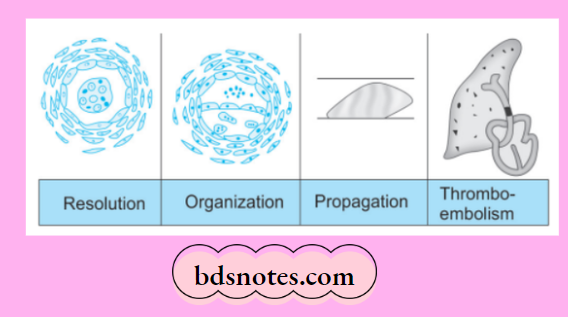
Fate of Thrombus
- Resolution: Thrombus activates the fibrinolytic system with the release of firing which may dissolve the thrombi completely resulting in the resolution. Usually, lysis is complete in small venous thrombi while large thrombi may not be dissolved. Fibrinolytic activity can be accentuated by the administration of thrombolytic substances, especially in the early stage when firing is in monomeric form.
- Organization: If the thrombus is not removed, it starts getting organized.
- Phagocytic cells phagocytosed firing and cell debris.
- The proteolytic enzymes start digesting the coagulum.
- Capillary grows in the thrombus from the site of its attachment and fibroblast starts invading the thrombus.
- Thrombus in this way becomes the part of vessel wall.
- The new vascular channels in it may re-establish the blood flow. It is called as recanalization.
- The fibrosis thrombus may undergo hyalinization and calcification.
Propagation: The thrombus may enlarge in size due to more deposition from constituents of flowing blood and obstructing some important vessels.
Thromboembolism: Thrombi in the early stage or infected thrombi are friable and may get detached from the vessel wall which produces ill effects at the site of their lodgement.
Leave a Reply