Crossbite: Definition, Causes, And Treatment
Describe in detail the etiology, clinical features, and management of crossbite.
Or
Writea short note on Crossbite.
Answer. Crossbite is defined as the condition where one or more teeth may be abnormally malposed, buccally lingually, or labiallyconcerningo the opposing tooth or teeth. Crossbite is of two types, i.e., anterior and posteriorcrossbitee.
“Understanding the role of crossbite in dental health”
Classification
- According to their location in the arch
- Anterior crossbite
- Single tooth crossbite
- Segmental crossbite.
- Posterior crossbite
- Single tooth crossbite
- Segmental crossbite.
- Anterior crossbite
- Classification of posterior crossbite based on its presence on one or both sides of the arch
- Unilateral posterior crossbite
- Bilateral posterior crossbite.
- According to the extent of crossbite
- Simple posterior crossbite
- Buccal non-occlusion Or scissor bite
- Lingual non-occlusion.
- Classification of crossbite based on the structure involved
- Dental crossbite
- Skeletal crossbite
- Functional crossbite.
“Importance of studying crossbite for better treatment outcomes”
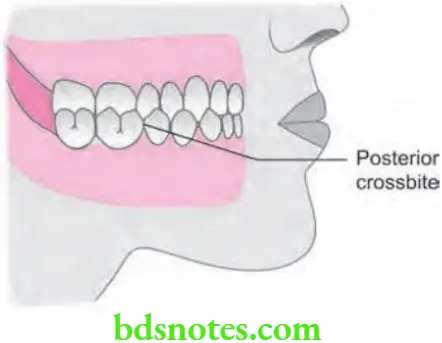
“Common challenges in diagnosing and treating crossbite”
Etiology of Anterior Crossbite
Skeletal Factors
Skeletal incisor crossbite results due to excessive mandibular growth. It is genetic or inherited malocclusion.
Dental Factors
- A dental incisor crossbite is because of abnormal axial inclination of the maxillary incisors.
- Abnormal axial inclination is due to the following factors, i.e., Inadequate arch length,h which leads to lingual eruption of permanent tooth.
- Labial position the f supernumerary tooth.
- Over retained primary tooth.
- Lip biting habit
- Trauma to primary teeth or the permanent tooth bud
“Asymptomatic vs symptomatic effects of poor communication”
Functional Factors
An incisor crossbite also occurs due to functional interference of the mandible during closure. It is due to premature tooth contact and results in pseudo-classthree3 malocclusion.
Etiology of Posterior Crossbite
Dental Crossbite
- Anomalies of tooth size, i.e., Microdontia and macrodontia
- Anomalies of tooth number, i.e., Supernumerary teeth and missing teeth.
- Anomalies of tooth shape, i.e., germination, fusion skeletal crossbite.
- Oral habits like thumb sucking, mouth breathing, etc.
- Trauma at birth
“Steps to explain the definition and types of crossbite in orthodontics”
Clinical Features of Anterior Crossbite
An abnormal labiolingual relationship, i.,e. reverse overjet is present between one or more maxillary and mandibular anterior teeth.
Clinical Features of Posterior Crossbite
An abnormal buccolingual relationship of teeth inthe maxilla and mandible when two dental arches are brought into centric occlusion.
Management of Posterior Crossbite
Single-tooth dental crossbite
- It involves the molars, which are treated by crossbite elastics.
- Such elastics are stretched betweenthe maxillary palatal surface and the mandibular buccal surfaces.
- Such elastics are to be worn both day and night. Treatment is not continued for more than 6 weeks as elastics cause extrusion of teeth.
Dentoalveolar contraction and crossbite
- First of all, any of the functional interference that is present should be eliminated by occlusal equilibration, i.e., A dental bilateral lingual crossbite in deciduous or mixed dentition is simply corrected by removing occlusal interferences, mainly in cuspid areas. This sometimes needs to be accompanied by some of the appliances.
- Various appliances which are to be given after occlusal equilibration are:
“Early warning signs of untreated underlying causes of crossbite”
- Coffin spring: It is a removable appliance that consists of an omega-shaped wire of 1.25 mm diameter, which is placed in the palatal region. The free ends of omega are embedded in an acrylic plate that covers the lopes of the palate. Spring causes dentoalveolar expansion. It causes skeletal changes when used in young patients.
- Quad helix: This spring consists of four helices. It causes dentoalveolar expansion of both the molar and premolar regions. It causes skeletal expansion when used in younger patients.
- Removable plates
- Removable appliances incorporating jackscrew are used to treat unilateral crossbites.
- The appliance consists of a split acrylic plate, a jack screw, and Adam’s clasp on posterior teeth to retain the plate. The labiall bow can also be incorporated into the appliance for minor space closure and retraction.
- Fixed appliances: Unilateral crossbites can also be treated by using fixed appliances.
“Role of anterior vs posterior crossbite in dental alignment”
Skeletal Crossbite
It is either due to the resence of a narrow maxilla or a narrow mandible.
- In patients with narrow maxillae, which have mild skeletal crossbite, quad helix or W arch is used,d while ie severe cases, RME or Minnesota expander is beneficial.
- In patients with narrow mandibles, e-functional appliances are used.
- If skeletal crossbite is very severe, re-surgical treatment is done.
Leave a Reply