Crazing Of Acrylic Resins
Write a short note on crazing.
Answer:
Crazing is the formation of very fine microcracks or flaws on the surface of the denture.
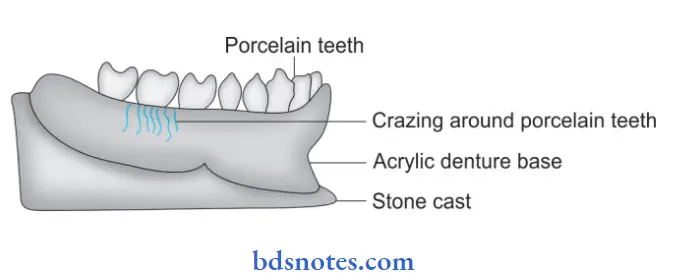
Mechanism of Formation:
It occurs due to the mechanical separation of individual polymer chains on the application of tensile stresses. Crazing starts from the surface of resin and is oriented at a right angle to tensile force. Microcracks form in this manner subsequently progress internally.
The appearance of Crazing:
In transparent resins, appearance is hazy or foggy while in tinted resin it is white in appearance.
Effects of Crazing:
- It decreases the strength of the denture leading to the fracture of the denture base.
- The esthetic qualities of dentures are reduced.
- It leads to the collection of food and debris and denture become unhygienic.
Causes For Occurrence Of Crazing:
- As dentures get subjected to cycles of frequent drying and water sorption it leads to crazing
- This happens when the patient frequently removes the denture and dries it out which leads to induction of sufficient tensile stresses which causes crazing.
- Due to the difference in thermal expansion between porcelain and acrylic resin, crazing occur at neck of porcelain teeth.
- At the time of denture repair when the monomer contact with cured acrylic resin of broken fragments microcracks may appear.
- Crazing can also result due to solvent action.
- It occur due to prolonged contact with liquids, i.e. ethyl alcohol.
Prevention of Crazing
- By use of improved acrylic resin teeth and cross-linked denture-based resins.
- By avoiding porcelain teeth.
- By using tin foil separating medium.
- By using metal molds.
Leave a Reply