Congenital Syphilis
Question 1. Write a short note on congenital syphilis.
Answer:
Congenital syphilis may develop in the fetus of more than 16 weeks gestation who is exposed to maternal spiro chaetae mia, there can be three possibilities:
1. Child born dead: The child is premature with macerated skin, enlarged spleen and liver with syphilitic epiphysis.
2. Child born alive: The child may show mucocutaneous lesion of acquired secondary syphilis. The bridge of nose may fall due to ulceration and destruction giving the characteristic ‘saddle nose’ appearance.
Congenital syphilis symptoms
3. Late type: Lesions appear after some years. The characteristic ‘Hutchinson’s teeth’ seen in this type are small, widely spaced, peg-shaped permanent teeth.
Morphologic features of congenital syphilis are:
- Saddle-shaped nose deformity due to destruction of bridge of nose.
- Characteristic Hutchinson teeth which are small widely spaced and peg-shaped permanent teeth.
- Mucocutaneous lesion of acquired secondary syphilis.
- Bony lesions such as epiphysitis and periostitis.
- Interstitial keratitis with corneal opacity
- Diffuse firosis in liver
- Interstitial firosis of lungs
- If fetus with congenital syphilis is born dead, it is premature with macerated skin, enlarged spleen and liver with syphilitic epiphysitis.
Question 2. Write a short note on pathology and lab diagnosis of actinomycosis.
Answer:
Pathology of Actinomycosis
Depending on the anatomic location of lesions, antinomy- costs is of four types:
1. Cervicofacial actinomycosis: Infection enters from tonsils, carious teeth, periodontal disease or trauma following tooth extraction.
Initially, a film swelling develops in lower jaw. In time, the mass breaks down and abscesses and sinuses are formed.
The discharging pus contains typical tiny yellow sulphur granules. The infection may extend into adjoining tissues as well as destroy bone.
2. Thoracic actinomycosis: Infection in the lungs is due to aspiration of the organism from oral cavity or extension of infection from abdominal or hepatic lesions.
3. Abdominal actinomycosis: Abdominal infection results from the swallowing of organisms from oral cavity or extension from the thoracic cavity.
4. Pelvic actinomycosis: Infection in the pelvis occurs as a complication of IUCD.
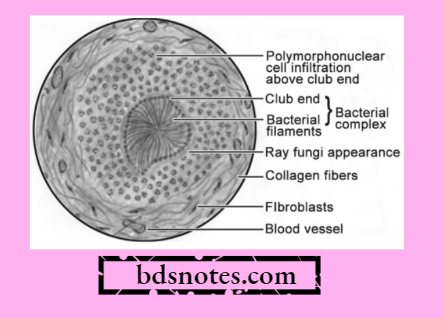
Lab Diagnosis of Actinomycosis
Following are the laboratory diagnosis of actinomycosis.
- Biopsy: Biopsy from the lesional tissue is taken and is assessed microscopically. On microscopic examination, the following features are seen:
- There is the presence of a granuloma with central suppuration.
- There is a formation of abscess in the center of lesion and at the periphery are seen chronic inflammatory cells, giant cells and fibroblasts.
- Center of each abscess contains a bacterial colony ‘sulfur granule’ characterized by radiating filaments with hyaline, eosinophilic, club-like representatives of secreted immunoglobulins.
- Pus from the lesion is collected and sulfur granules are demonstrated by shaking the pus in test tube with saline. Granules are white or yellow-ish in color and measure about 5 mm. On standing granules sediment and are withdrawn with a capillary pipette.
Hutchinson triad in syphilis
Granules are crushed between the slides and are stained with Gram stain.
Granules are bacterial colonies that consist of thin, Gram-positive filaments surrounded by a peripheral zone of swollen radiating club-shaped structures presenting a sun-ray appearance.
- By Gomori’s methenamine silver stain the organism stain positively.
Leave a Reply