Silicon Impression Material
Condensation Silicone:
It is also known as conventional silicones.
Composition Of Condensation Silicone:

“Importance Of Condensation Silicone In Dental Impressions”
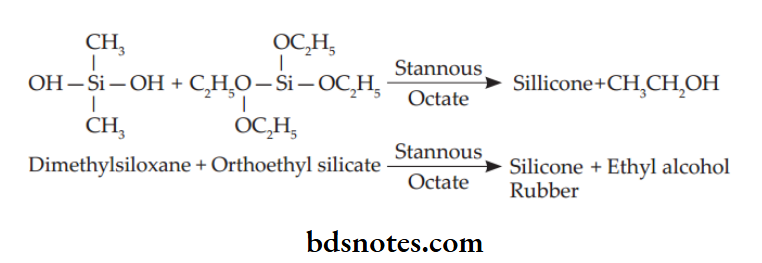
Setting Reaction of Condensation Silicone
It is a condensation reaction. Polymerization occurs as a result of cross-linkage between the ortho-ethyl silicate and terminal hydroxy group of dimethylsiloxane to form a three-dimensional network. Ethyl alcohol is the by-product of the reaction which evaporates causing contraction of set condensation silicone impression. Reaction is exothermic with temperature rise of 1°C.
Condensation Silicone In Dentistry
“Risk Factors For Failure With Condensation Silicone Impressions”
Properties of Condensation Silicone:
Condensation Silicone has pleasant color and odor.
- Condensation Silicone setting time is 6 to 9 minutes, while the mixing time is 45 seconds.
- Condensation Silicone is non-toxic but direct skin contact should be avoided.
- Excellent reproduction of surface details.
- Dimensional stability is comparatively less because of high curing shrinkage (0.4 to 0.65).
- Tear strength (3000) g/cm is lower than the polysulfides.
- Condensation Silicone is stiffer than polysulfide.
- Condensation Silicone is hydrophobic so field should be dried before making the impression.
- Condensation Silicone can be plated with silver/copper.
- Shelf-life is slightly less than polysulfide.
Uses Of Condensation Silicone

“Early Signs Of Problems With Condensation Silicone Impressions”
Advantages of Condensation Silicone:
- Condensation Silicone does not consist of bad odor of polysulphides.
- Basic advantages of elastomeric impression materials are present.
Disadvantages of Condensation Silicone:
- Shelf life is limited.
- As by-products are formed after the chemical reaction, the impression cannot be kept for an extended period of time.
- Due to the evaporation of ethyl alcohol dimensional stability is affected.
Manipulation of Condensation Silicone:
Following are the methods of manipulating condensation silicone, i.e.
- Hand mixing
- Static auto mixing system.
Properties Of Condensation Silicone
1. Hand Mixing:
- High viscosity material, i.e. put is usually supplied in small tubs with different colored scoops for identification and dispensing.
- Equal quantities of both the pastes are taken.
- Mixing is done by hand by kneading the material together to obtain a uniform mix without any streaks.
- Manufacturers also supply in base and catalyst in separate tubes with a much smaller diameter opening for catalyst,to enable dispensing equal lengths of base and catalyst,
though the volume being different. - For condensation silicone, the quantity of reactor paste needed is very little.
- So the base and reactor pastes are extruded on a mixing pad with an unequal length of base and catalyst on a paper pad and manipulated by a stiff bladed spatula in a circular motion for 45 seconds till the mix is free from streaks.
“Difference Between Condensation And Addition Silicone Impression Materials”
2. Static Automixing System:
- These days many of the materials are now dispensed by an extruder gun with a mixing tip.
- The base and catalyst are stored or supplied in separate cylinders of the plastic cartridge.
- The extruder gun contains two plungers on which these cylinders are placed.
- Now the base and catalyst are forced through the mixing tip.
- Static Automixing System consists of a stationary plastic internal spiral that brings together the correct volume of both base and catalyst, and dispenses it premixed.
Condensation Silicone Composition
“Role Of Condensation Silicone In Crown And Bridge Impressions”
- Apply the mixed material directly over the prepared teeth and/or on the impression tray.
- The advantages of the mixing tip include dispensing of the correct ratio of base and catalyst and uniform mixing without the incorporation of air bubbles.
- Condensation silicones are available in these systems.
- Static Automixing System is stiffr than polysulfide.
- Static Automixing System is hydrophobic.
Leave a Reply