Components Of X-Ray Tube
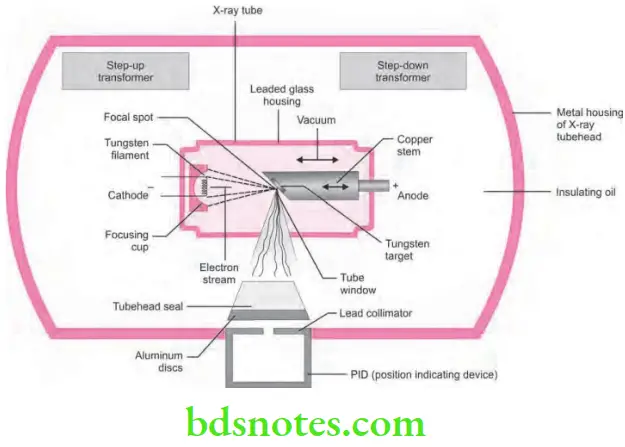
Define radiation. Explain with the help of diagram the construction of X-ray tube and production of X-rays.
or
Discuss in detail about production of X-ray. draw a well-labeled circuit diagram of X-ray tube.
or
Draw a labeled diagram for X-ray tube and discuss production of X-rays.
Answer. Radiation is defined as the emission and propagation of energy through space or a substances in form of waves or particles.
Construction of X-ray tube
- X-ray tube: It is the main X-ray generating system. It consists of three parts i.e. lead glass housing, negative cathode and positive anode.
- Lead glass housing is a glass vacuum tube which prevents X-rays in escaping all the directions.
- Negative cathode consists of filament and focusing cup. Filament is basically a coiled wire of tungsten and produces electron on heating. Focusing cup is a holder formed by molybdenum and it houses the filament. Focusing cup focus electrons in a narrow beam and direct beam across the tube towards tungsten target of anode. Cathode supply the electrons which are necessary in generation of X-rays.
- Positive anode converts electrons into X-ray photons. Anodes are of two types, i.e. stationary and rotating anode.
- Circuits: In X-ray machine, two types of circuits are used, i.e. filament circuit or high voltage circuit.
- Filament circuit is of low voltage, i.e. 3 to 5 volts. It regulates flow of electric current to filament of X-ray tube.
- High voltage circuit uses 65,000 to 1,00,000 volts which provide high voltage required to accelerate electrons for generation of X-rays in X-ray tube
- Transformers: It either increases or decrease voltage in an electrical circuit. Transformers are of three types i.e.
- Step-down transformer: It decreases the voltage from incoming 110 to 220 line voltage to 3 to 4 volt as required for the filament circuit.
- Step-up transformer: It increases the voltage from incoming 110 to 220 line voltage to 65,000 to 1,00,000 volts as required by high voltage circuit.
- Auto transformer: It serves as a voltage compensator, which correct minor fluctuation in current.
- Timer: It completes the circuit with high voltage transformer and controls the time for which high voltage is applied to the tube.
- Tube rating: It is the maximum safe interval the tube is energized at given range of voltage (kVp) and the tube current (mA) values.
- Duty cycle: It refers to how frequently successive exposures can be made.
Leave a Reply