Cold Abscess Causes Investigations And Treatment
Question 1. Write a short note on the Cold Abscess
Or
Write in brief about the Cold Abscess
Answer.
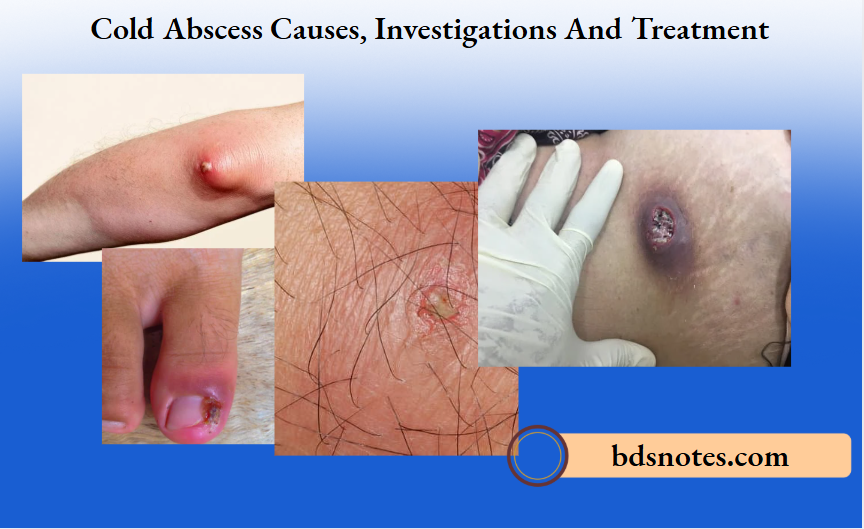
Cold Abscess Definition
A cold abscess is also known as Tuberculous Abscess.
The abscess shows no signs of acute inflammation, which is why it is known as a cold abscess.
It occurs most commonly in the neck, groin, psoas region, and paraspinal area.
“Understanding cold abscess through FAQs: Causes, investigations, and treatments explained”
“Importance of studying cold abscess for medical professionals: Questions explained”
Cold Abscess Areas Of Origin or Cold Abscess Causes
- In tuberculous lymphadenitis, the cold abscess is commonly seen in the anterior triangle of the neck.
- In tuberculosis of the cervical spine, cold abscesses occur in the posterior triangle of the neck.
Read And Learn More: General Surgery Questions and Answers
Cold Abscess Clinical Features
- It is more common in younger age groups and is seen at any age.
- There is the presence of swelling over the neck, which is smooth, soft, fluctuant, non-tender, non-transilluminate, and has restricting mobility.
- With the change in posture when the patient is seated, he supports his heawith hisis hands and forearm. This is known as Rust’s sign.
- There is also the presence of evening fever, loss of weight, appetite,e, and anemia.
- Mattd lymph nodes are present adjacent to colabscessesss, which are palpable. The abscesss shows no signs of acute inflammation.
“Common challenges in diagnosing and treating cold abscess effectively: FAQs provided”
“Factors influencing success with cold abscess knowledge: Q&A”
Cold Abscess Investigations
- ESR is raised.
- Mantoux test is positive.
- Presence of anemia and lymphocytosis
- Chest X-ray shows pulmonary tuberculosis
- On FNAC, epithelioid cells are seen.
- X-ray of the neck in the tuberculous cervical spine is done to identify reduced joint space, vertebral destruction, and soft tissue shadow.
- MRI of the cervical spine and a US/CT scan of the neck are needed to confirm the anatomical location and number of lesions.
Cold Abscess Sequelae
- Secondary infection occurs in a cold abscess, and it becomes tender.
- Collar stud abscess fors, as pressure increases in coldabsces ss it provides a way through the deep fascia to reach the subcutaneous plane and adhere to the skin.
- Formation of the sinus.
- Disease spread to other lymph nodes and organs.
“Steps to explain cold abscess: Causes vs symptoms vs treatment: Q&A guide”
Cold Abscess Differential Diagnosis
- Branchial cyst and other cystic swellings of the neck.
- Secondaries of neck lymph nodes
- Secondaries in the cervical spine.
Cold Abscess Treatment
- Anti-tubercular drugs should be started.
- Zig-zag aspiration by wide bore needle in non-dependent aspiration of cold abscess.
- Excision of affected lymph nodes
- The cervical spine should be immobilized by a plaster jacket for 4 months.
- Drainage using non-dependent incision and later closure of wound without placing the drain.
“Role of tuberculosis in causing cold abscess: Questions answered”
Question 2. Describe the differentiating features of Acute Abscess and Cold Abscess.
Answer.

Leave a Reply