Coagulation Of Blood
Describe the mechanism of coagulation of blood mention different anticoagulants and mechanism of action. (or) Anticoagulants. (or) Coagulation of blood.
Answer:
Coagulation:
Coagulation or clotting is the process in which blood losses its fluidity and becomes a jelly like mass few minutes after it is shed out or collected in a container.
- Coagulation Mechanism:
- The coagulation of blood involves a ‘complex series’ or ‘cascade’ of reactions.
- The clotting of blood occurs in three stages.
“Understanding coagulation of blood through FAQs: Mechanisms, functions, and uses explained”
1. Formation of Prothrombin activator:
- Prothrombin activator is formed in two ways.
- Extrinsic pathway:
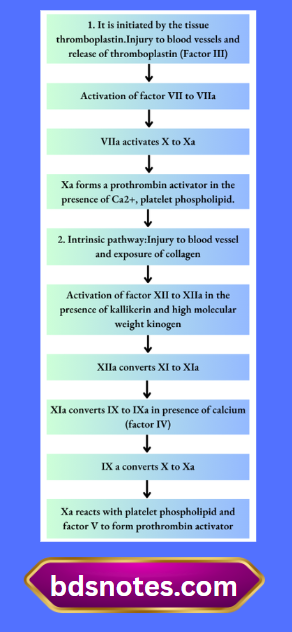
“Importance of studying coagulation of blood for medical students: Questions explained”
2. Conversion of prothrombin into thrombin:
- Prothrombin activator converts prothrombin into thrombin in the presence of calcium.
- The thrombin thus formed initiates the formation of further molecules of thrombin.
- This activates factor V which accelerates both extrinsic and intrinsic pathway for the formation of prothrombin activator.
Coagulation of blood
3. Conversion of Fibrinogen into fibrin:

“Common challenges in mastering coagulation notes effectively: FAQs provided”
Anticoagulants and its mechamism:
1. Heparin:
- It is naturally occurring anticoagulant.
- It is produced by mast cells and circulating basophils.
- It is present in liver and lungs.
Heparin Mechanism:
- Suppresses the activity of thrombin.
- Combines with heparin cofactor and shows anticoagulant action.
- Activates antithrombin III
- Combines with antithrombin III and removes thrombin from circulation.
- Inactivates the active form of clotting factors IX, X, XI and XII
“Factors influencing success with coagulation studies: Q&A”
2. Coumarin dervicaties [Dicoumoral and warfarin]:
- It inhibits the action of vitamin K.
- As vitamin K is essential for the formation of various clotting factors like VII, IX and X, it inhibits coagulation.
3. EDTA (Ethylenediaminetetra acetic acid):
- It prevents blood clotting by removing calcium from blood
4. Oxalate compounds and citrates:
- These combines with calcium and forms insoluble calcium oxalate and calcium citrate respectively,.
- This reduces the calcium level of blood which prevents blood clot.
Leave a Reply