• Skip to main content
  • Skip to secondary menu
  • Skip to primary sidebar
  • About Us
  • Terms of Use
  • Privacy Policy
  • Disclaimer
  • Contact Us
  • Sitemap

BDS Notes

BDS notes, Question and Answers

  • Public Health Dentistry
  • Periodontics
  • Pharmacology
  • Pathology
  • Orthodontics
    • Anchorage In Orthodontics
    • Mandibular Growth, Functional Matrix
    • Retention and Relapse
  • General Surgery
    • Cysts: Types, Causes, Symptoms
    • Maxillofacial Fractures, Disorders, and Treatments
    • Lymphatic Disorders
    • Neurological and Facial Disorders
  • Temporal And Infratemporal Regions
    • Spinal and Neuroanatomy
  • Dental Materials
    • Dental Amalgam
Home » Clinical Approach To A Case Of Purpura

Clinical Approach To A Case Of Purpura

September 17, 2025 by Marksparks .arkansas Leave a Comment

Clinical Approach To A Case Of Purpura

Question. Write a short note on Purpura.

Answer. Any rash in which blood cells leak into the skin or mucus membrane, usually at multiple sites.
Purpuric rashes are often associated with disorders of coagulation or thrombosis.
Pinpoint purpuric lesions are called petechiae, large hemorrhages into the skin are called as ecchymoses.

Types Of Purpura

  • Allergic purpura: Any of a group of purpuras caused by a variety of agents, including bacteria, drugs and food.
  • Anaphylactic purpura or Henöch-Schönlein purpura: A form of small vessel vasculitis that affcts children more commonly than adults, it is marked by abdominal pain, polyarticular joint disease and purpuric lesions of the lower extremities.
  • Idiopathic thrombocytopenic purpura or hemorrhagic purpura:
    It is hemorrhagic autoimmune disease in which there is destruction of circulating platelets, caused by autoantibodies that bind with antigen on the platelet membrane.

Clinical Approach to a Case of Purpura
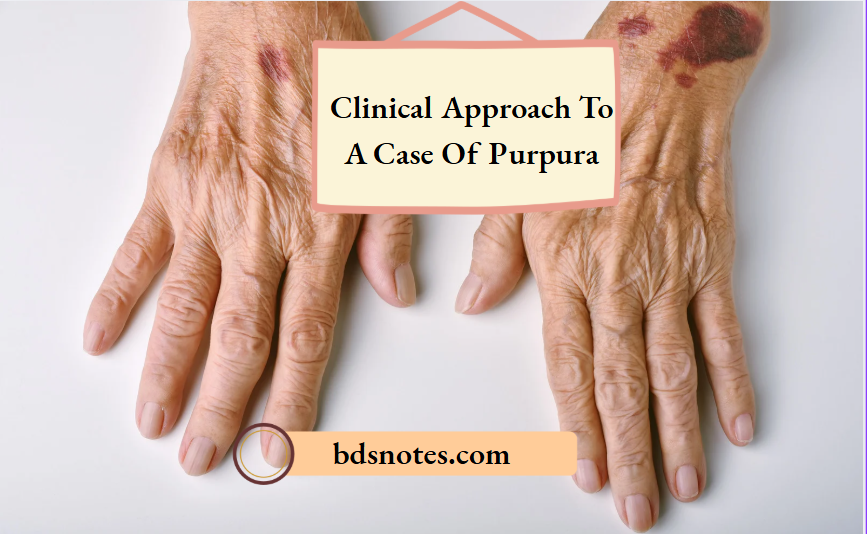
Clinical Approach To A Case Of Purpura

Symptoms

  • Bleeding from nose, the gums or the gastrointestinal tract.
  • Physical fidings include petechiae, especially on the lower extremities and ecchymoses.

laboratory Findings

Platelet count is usually less than 100, 000 per cumm.

Purpura Diagnosis and Clinical Management

Treatment

  • If patient are asymptomatic and platelet count is about 40,000 per cumm, treatment is unnecessary.
  • For symptomatic patients, treatment regimen include high dose corticosteroid, IV immunoglobulin, splenectomy.

Filed Under: General Medicine

Reader Interactions

Leave a Reply Cancel reply

Your email address will not be published. Required fields are marked *

Primary Sidebar

Recent Posts

  • Branchial Cleft Cyst: Background, Pathophysiology, Etiology
  • Maxillary Nerve: Origin, Course, And Branches
  • The Father Of Anatomy And A Great Anatomist Herophilus
  • Bone Structure – Anatomy
  • The External Carotid Artery: Anatomy, Branches, And Functions
  • Occipitofrontalis Muscle
  • Superficial Temporal Artery
  • Platysma Muscle
  • Cartilage
  • Cauda Equina And Conus Medullaris Syndromes
  • Subcutaneous Injections And Device Management
  • Types Of Circulation: Pulmonary, Systemic, And Portal
  • Structure Of Skeletal Muscle
  • Elastic Cartilage
  • Cellular Organelles And Structure
  • The Golgi Apparatus – The Cell
  • The Cytoplasmic Inclusions Of Certain Plant Cells
  • Dental Abscess
  • Laser Surgery
  • Our Facial Muscles And Their Functions

Copyright © 2026 · Magazine Pro on Genesis Framework · WordPress · Log in