Chronic Periodontitis
Classify gingival and periodontal diseases. Describe the characteristic features of slowly progressive periodontitis in detail.
Answer.
Classification of Gingival and Periodontal Disease:
The classification by American Academy of Periodontology (AAP) 1999 (International Workshop for Classification of Periodontal Disease) is as follows:
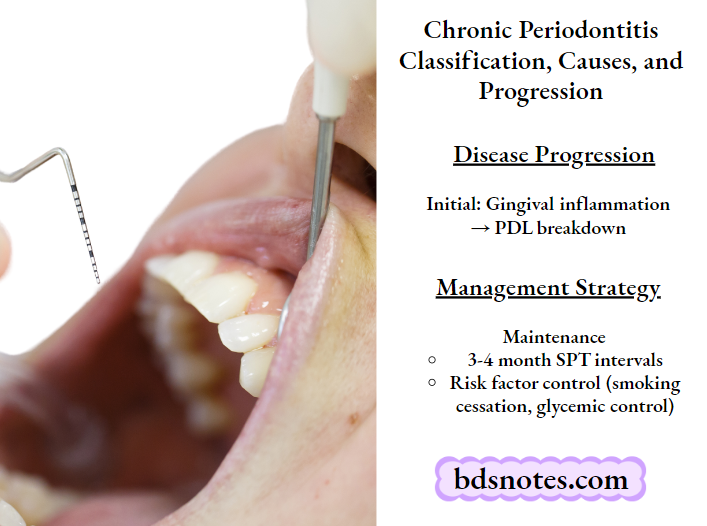
“Best Ways To Understand Chronic Periodontitis Progression”
Gingival Disease
Dental plaque-induced gingival diseases: These disease may occur on periodontium with no attachment loss or someone with attachment loss that is stable and not progressing.
- Gingivitis associated with dental plaque only:
- Without local contributing factors.
- With local contributing factors.
- Gingival diseases modified by systemic factors:
- Associated with endocrine system:
- Puberty-associated gingivitis.
- Menstrual cycle-associated gingivitis.
- Pregnancy-associated.
- Gingivitis
- Pyogenic granuloma.
- Diabetes mellitus associated gingivitis.
- Associated with endocrine system:
“Importance Of Early Treatment For Chronic Periodontitis”
Read And Learn More: Periodontics Question And Answers
- Associated with blood dyscrasias:
- Leukemia-associated gingivitis.
- Others.
- Associated with blood dyscrasias:
- Gingival diseases modified by medications:
- Drug-influenced gingival diseases:
- Drug-influenced gingival enlargements.
- Drug-influenced gingivitis.
- Oral contraceptive-associated gingivitis
- Others.
- Drug-influenced gingival diseases:
- Gingival diseases modified by malnutrition:
- Ascorbic acid deficiency gingivitis.
- Others.
“Role Of Bacteria In Causing Chronic Periodontitis”
Non-plaque-induced gingival lesions:
- Gingival diseases of specific bacterial origin:
- Neisseria gonorrhoeae.
- Treponema pallidum.
- Streptococcal species.
- Others.
- Gingival diseases of viral origin:
- Herpes virus infections.
- Primary herpetic gingivostomatitis
- Recurrent oral herpes
- Varicella-zoster.
- Others.
- Herpes virus infections.
“Understanding The Role Of Bacteria In Chronic Periodontitis”
- Gingival diseases of fungal origin:
- Candida species infections: generalized gingival candidiasis.
- Linear gingival erythema.
- Histoplasmosis.
- Others.
- Gingival lesions of genetic origin:
- Hereditary gingival fibromatosis.
- Others.
- Gingival manifestations of systemic conditions:
- Mucocutaneous lesions:
- Lichen planus.
- Pemphigoid.
- Pemphigus vulgaris.
- Erythema multiforme.
- Lupus erythematosus.
- Drug induced.
- Others.
- Allergic reactions:
- Dental restorative materials:
- Mercury
- Nickel
- Acrylic
- Others.
- Reactions attributable to:
- Toothpastes or dentifrices
- Mouth rinses or mouthwashes
- Chewing gum additives
- Foods and additives.
- Others.
- Dental restorative materials:
- Mucocutaneous lesions:
- Traumatic lesions (factitious, iatrogenic, or accidental):
- Chemical injury.
- Physical injury.
- Thermal injury.
- Foreign body reactions.
- Not otherwise specified (NOS).
“Step-By-Step Guide To Identifying And Treating Chronic Periodontitis Safely”
Chronic Periodontitis
- Localized: Less than 30% of sites involved.
- Generalized: More than 30% of sites involved.
- Slight: 1–2 mm clinical attachment loss.
- Moderate: 3–4 mm clinical attachment loss.
- Severe: More than 5 mm clinical attachment loss.
Aggressive Periodontitis
- Localized: Slight, moderate or severe.
- Generalized.
Periodontitis as a Manifestation of Systemic Diseases
- Associated with hematological disorders:
- Acquired neutropenia.
- Leukemias.
- Others.
- Associated with genetic disorders:
- Familial and cyclic neutropenia.
- Down syndrome.
- Leukocyte adhesion defiiency syndrome.
- Papillon-Lefévre syndrome.
- Chèdiak-Higashi syndrome.
- Histiocytosis syndrome.
- Glycogen storage disease.
- Infantile genetic agranulocytosis.
- Cohen syndrome.
- Ehlers-Danlos syndrome (Types 4 and 8).
- Hypophosphatasia.
- Others.
“Tips To Prevent Complications From Untreated Chronic Periodontitis”
Necrotizing Periodontal Diseases
- Necrotizing ulcerative gingivitis.
- Necrotizing ulcerative periodontitis.
Abscesses of the Periodontium
- Gingival abscess.
- Periodontal abscess.
- Pericoronal abscess.
Periodontitis Associated with Endodontic Lesions
Combined periodontic-endodontic lesions.
Developmental or Acquired
Deformities and Conditions:
- Localized tooth-related factors that modify or predispose to plaque-induced gingival diseases/periodontitis:
- Tooth anatomic factors.
- Dental restorations/appliances.
- Root fractures.
- Cervical root resorption and cemental tear.
- Mucogingival deformities and conditions around teeth:
- Gingival/sof tissue recession, facial or lingual surfaces, interproximal (papillary).
- Lack of keratinized gingiva.
- Decreased vestibular depth.
- Aberrant frenum/muscle position.
- Gingival excess:
- Pseudopocket
- Inconsistent gingival margin
- Excessive gingival display
- Gingival enlargement.
- Abnormal color.
- Mucogingival deformities and conditions on edentulous ridges:
- Vertical and/or horizontal ridge deficiency.
- Lack of gingival/keratinized tissue.
- Gingival/soft tissue enlargement.
- Aberrant frenum/muscle position.
- Decreased vestibular depth.
- Abnormal color.
- Occlusal trauma:
- Primary occlusal trauma.
- Secondary occlusal trauma.
“The Role Of Scaling And Root Planing In Managing Chronic Periodontitis”
Slowly Progressive Periodontitis
- Slowly Progressive Periodontitis is also known as chronic periodontitis or adult periodontitis.
- Slowly Progressive Periodontitis is defined as an infectious disease resulting in inflammation within the supporting tissues of the teeth leading to progressive attachment and bone loss.
Gingival and Periodontal Disease Characteristic Features
- Gingival and Periodontal Disease is mostly prevalent in adults but can be seen in children.
- Gingival and Periodontal Disease is associated with the variable microbial pattern.
- Amount of destruction present in chronic periodontitis is consistent with the local factors.
- Presence of subgingival calculus frequently.
- Gingival and Periodontal Disease rate of progression is slow to moderate with periods of rapid progression.
- Immunologically none of the abnormalities are detected.
“Best Practices For Post-Chronic Periodontitis Care And Recovery”
- Gingival and Periodontal Disease is localized when less than 30% of the sites are involved and generalized when more than 30% of the sites are involved.
- Presence of the local factors directly relates to the amount of destruction present.
- Gingival and Periodontal Disease lacks strong evidence of correlation between particular genes and periodontitis. So, there is no evidence of familial aggregation.
Leave a Reply