Chronic Inflammation
Write a short note on chronic inflammation.
Answer:
Chronic inflammation is defined as the prolonged process in which tissue destruction and inflammation occur at the same time.
Various Ways of Chronic Inflammation
- Chronic inflammation following acute inflammation. When the tissue destruction is extensive, and the bacteria survive in small numbers at site of acute inflammation.
- Recurrent attacks of acute inflammation.
- Chronic inflammation starts when an infection with an organism of low pathogenicity occurs.
Chronic inflammation pathology
Morphologic Features of Chronic Inflammation
- Mononuclear cell infiltration: Chronic inflammatory lesions are infiltrated by mononuclear inflammatory cells like phagocytes and lymphoid cells. Other chronic inflammatory cells include lymphocytes, plasma cells, eosinophils and mast cells.
- Tissue destruction or necrosis: This is brought about by activated macrophages with the release of a variety of biologically active substances, e.g. protease, elastase, collagenase, cytokines, etc.
- Proliferative changes: As a result of necrosis proliferation of small blood vessels and fibroblasts is stimulated resulting in the formation of inflammatory granulation tissue.
Systemic Effects of Chronic Inflammation
- Fever: Mild fever with loss of weight and weakness
- Anemia
- Leucocytosis: There is relative lymphocytosis
- ESR: It is elevated in chronic inflammation
- Amyloidosis: Long-term cases of chronic suppurative inflammation may develop secondary systemic amyloidosis.
Types of Chronic Inflammation
- Nonspecific: There is a non-specific chronic inflammatory reaction with the formation of granulation tissue and healing with fibrosis, For Example. chronic osteomyelitis, chronic ulcer.
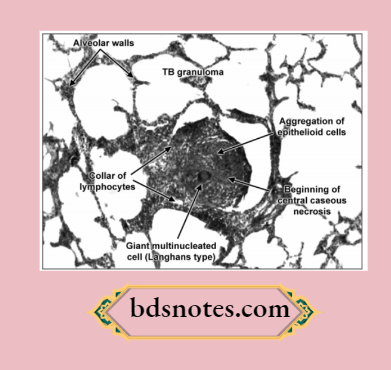
- Specific: When there is a characteristic histologic tissue response, For Example. tuberculosis and syphilis.
Cells involved in Chronic Inflammation
- Lymphocytes: They are mobilized in antibody-mediated, cell-mediated as well as non-immune inflammation.
- Macrophages: They cause phagocytosis, initiate tissue repair, secrete mediators of inflammation and influence lymphocyte function.
- Eosinophil: They leads to recruitment and extravasation from blood driven by adhesion molecules like neutrophils and by eotaxin. These cells are also involved in IgE-mediated immune reactions and parasitic infestations. Major basic protein is a highly toxic protein contained in eosinophil granules. This protein is toxic to parasites and mammalian epithelial cells.
Cells of chronic inflammation
- Mast cells: They are present in connective tissue. They participate in acute and chronic inflammation. They express on their surface the receptor which binds to the Fc portion of the IgE antibody to degranulate mast cells and release mediators.
- Plasma cells: These are large cells with amphophilic to basophilic cytoplasm, an eccentric nucleus with chromatin arranged in a characteristic cart-wheel or clock-face pattern. The cytoplasm of a cell has a pale perinuclear zone which on electron microscopy shows extensive Golgi apparatus and centrioles. These cells have abundant rough endoplasmic reticulum which is coupled by well developed Golgi apparatus, which together are responsible for immunoglobulin secretion.
- Neutrophils: They are classically associated with acute inflammation, but sometimes are seen with chronic inflammation, For Example. chronic osteomyelitis
Leave a Reply