Cheiloscopy: Uncovering Crime Through Lip Prints
Question. Write a short note on chelioscopy.
Or
Write a short note on lip prints.
“Importance of studying cheiloscopy for better forensic outcomes: Questions explained”
Answer. The external surface of the lip has many elevations and depressions forming a characteristic pattern called lip prints, examination of which is referred to as coloscopy.
- This is unique for individuals like fingerprints.
- Lip prints can constitute material evidence left at a crime scene, much like fingerprints.
- Lip prints provide a direct link to the suspect.
- The use of lipstick was essential to leave behind color traces of lip prints.
“Understanding the role of cheiloscopy in forensic science: Q&A explained”
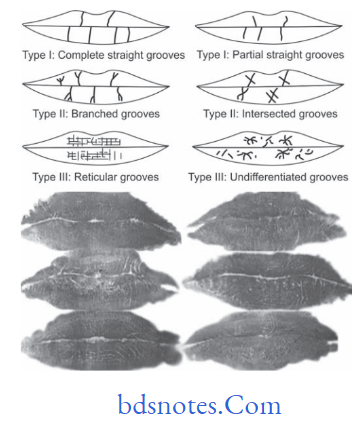
Classification of Lip Prints
By Tsuchihashi
- Type I Clear-cut vertical grooves that run across the entire lip
- Type I’- Similar to Type I but does not cover the entire lip
- Type II Branched grooves
- Type III Intersected grooves
- Type IV Reticular grooves
- Type V Grooves that cannot be morphologically differentiated
- A combination of these grooves may be found on any given set of lips.
- To simplify recording, lips are divided into quadrants similar to dentition, i.e., a horizontal line dividing the upper and lower lip and a vertical line dividing right and left sides. By noting the type of groove in each quadrant the individual’s lip print pattern may be recorded.
“Common challenges in analyzing lip prints effectively: FAQs provided”
Leave a Reply