
Metal Casting Processes Following are the differences between normal and hygroscopic setting expansion: "Best Ways To Understand Gingivectomy Vs. Gingivoplasty" All castings will shrink as the metal transitions from a liquid state to a solid state. As a casting cools there are three phases of shrinkage, liquid shrinkage, solidification shrinkage, and solid … [Read more...] about Metal Casting Processes: Understanding Shrinkage, Expansion, and Compensation Techniques
Dental Materials
Gypsum-Bonded Investments: Composition, Properties, and Uses in Dental Casting
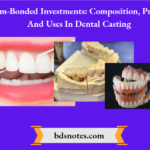
Gypsum Bonded Investments Gypsum-bonded investments are used for casting gold alloys. They can withstand temperatures up to 700°C. Classification of gypsum-bonded investment: As per ADA specification No. 2 Type I- For casting inlays or crowns Type II- For casting partial and complete denture bases. Dental Investment Materials "Best Ways To Understand … [Read more...] about Gypsum-Bonded Investments: Composition, Properties, and Uses in Dental Casting
Phosphate-Bonded Investment Materials: Composition, Properties, and Applications in Dentistry
Dental Materials And Their Selection An investment is defined as a ceramic material that is suitable for forming a mold into which molten metal or alloy is cast. Phosphate-bonded investments are the most commonly used investments in the casting of palladium-based alloys and base metal alloys. "Best Ways To Understand Phosphate-Bonded Investments In Dentistry" Dental … [Read more...] about Phosphate-Bonded Investment Materials: Composition, Properties, and Applications in Dentistry
Dental Casting Investment Materials: Types, Composition, and Applications
Dental Casting Investment Material An investment can be described as a ceramic material, which is suitable for forming a mold into which molten metal or alloy is cast. The procedure for forming the mold is described as “investing”. Materials such as gypsum, phosphate, and silicate are used for investment as they can withstand higher temperatures of burnout and casting … [Read more...] about Dental Casting Investment Materials: Types, Composition, and Applications
Flux and Anti-Flux in Soldering: Types, Functions, and Applications in Dentistry
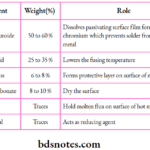
Soldering Fluxes Flux in Dentistry Flux is the compound that is applied to the metal surfaces which is to be joined to prevent the formation of oxides which reduce the strength of soldered area. "Importance Of Flux In Preventing Oxidation During Soldering" The function of Flux in Dentistry: Flux plays three roles, i.e. Flux removes impurities, i.e. dirt, oil, … [Read more...] about Flux and Anti-Flux in Soldering: Types, Functions, and Applications in Dentistry