• Skip to main content
  • Skip to secondary menu
  • Skip to primary sidebar
  • About Us
  • Terms of Use
  • Privacy Policy
  • Disclaimer
  • Contact Us
  • Sitemap

BDS Notes

BDS notes, Question and Answers

  • Public Health Dentistry
  • Periodontics
  • Pharmacology
  • Pathology
  • Orthodontics
    • Anchorage In Orthodontics
    • Mandibular Growth, Functional Matrix
    • Retention and Relapse
  • General Surgery
    • Cysts: Types, Causes, Symptoms
    • Maxillofacial Fractures, Disorders, and Treatments
    • Lymphatic Disorders
    • Neurological and Facial Disorders
  • Temporal And Infratemporal Regions
    • Spinal and Neuroanatomy
  • Dental Materials
    • Dental Amalgam
Home » Carcinoma In Situ in Oral Cavity – Signs, Symptoms, and Management

Carcinoma In Situ in Oral Cavity – Signs, Symptoms, and Management

May 26, 2025 by Kristensmith Taylor Leave a Comment

Carcinoma In Situ in Oral Cavity – Signs, Symptoms, and Management

Write a short note on carcinoma in situ.
Answer:

Carcinoma in situ

This is also called intraepithelial carcinoma.

“Early warning signs of oral carcinoma in situ explained”

  • Carcinoma in situ is a condition that arises frequently on the skin but also occurs on mucus membranes including those of the oral cavity.
  • Metastasis is impossible in intraepithelial carcinoma.
  • Bowen’s disease is a special form of intraepithelial carcinoma occurring with some frequency on the skin, particularly in patients who have had arsenic therapy and is often associated with the development of internal or extracutaneous cancer.

Carcinoma in situ oral cavity

“Role of surgical excision in treating oral carcinoma in situ”
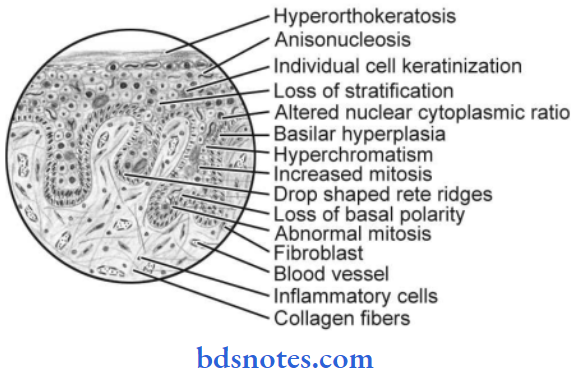
The Oral Cavity And Salivary Glands Carcinoma In Situ (H & E Stain)

“Understanding carcinoma in situ: Causes and symptoms”

Carcinoma in situ Histological Features

  • Keratin may or may not be found on the surface of the lesion but, if present, is more apt to be parakeratin rather than ortho-keratin.
  • In some instances, there appears to be hyperplasia of the altered epithelium while in others there is atrophy.
  • An increased nuclear/cytoplasmic ratio and nuclear hypo or hyperchromatism are sometimes seen.

Oral carcinoma in situ

“Global prevalence of oral carcinoma in situ”

  • Cellular pleomorphism is uncommon
  • There is a loss of orientation of cells and a loss of their normal polarity.
  • Sometimes a sharp line of division between normal or altered epithelium extends from the surface down to the connective tissue rather than a blending of epithelial changes.

Filed Under: Pathology

Reader Interactions

Leave a Reply Cancel reply

Your email address will not be published. Required fields are marked *

Primary Sidebar

Recent Posts

  • Branchial Cleft Cyst: Background, Pathophysiology, Etiology
  • Maxillary Nerve: Origin, Course, And Branches
  • The Father Of Anatomy And A Great Anatomist Herophilus
  • Bone Structure – Anatomy
  • The External Carotid Artery: Anatomy, Branches, And Functions
  • Occipitofrontalis Muscle
  • Superficial Temporal Artery
  • Platysma Muscle
  • Cartilage
  • Cauda Equina And Conus Medullaris Syndromes
  • Subcutaneous Injections And Device Management
  • Types Of Circulation: Pulmonary, Systemic, And Portal
  • Structure Of Skeletal Muscle
  • Elastic Cartilage
  • Cellular Organelles And Structure
  • The Golgi Apparatus – The Cell
  • The Cytoplasmic Inclusions Of Certain Plant Cells
  • Dental Abscess
  • Laser Surgery
  • Our Facial Muscles And Their Functions

Copyright © 2026 · Magazine Pro on Genesis Framework · WordPress · Log in