Carbohydrate Digestion And Absorption
Explain how starch, sucrose and lactose are hydrolyzed in the gastrointestinal tract. Add a note on glucose absorption.
Answer:
Digestion of carbohydrates in the gastrointestinal tract.
1. Digestion in the mouth:
- While food is chewed in the mouth before it is swallowed it mixes with saliva.
- The chewed food is subjected to the action of salivary a-amylase (ptyalin)
- This a-amylase aids in digestion of starch to produce dextrin and maltose.
“Understanding carbohydrate digestion through FAQs: Enzymes, processes, and uses explained”
2. Digestion in the stomach:
- The action of salivary amylase on starch and glycogen continues in the stomach.
- The HCI present in the gastric juice may hydrolyse some sucrose.
3. Digestion in the small intestine:
- Pancreatic amylase rapidly converts all form of starch into dextrin, maltose and maltroise.
- Its digestive activity is increased by presence of bile salts.
- Succus entericus contains enzymes for splitting disaccharides into monosaccharides.
“Importance of studying carbohydrate digestion for nutrition students: Questions explained”
They are:
- Sucrase-converts sucrose into glucose and fructose at pH 5-7.
- Maltase-converts maltose into glucose at pH 5.S-6.2.
- Lactase-converts lactose into glucose and galactose at pH 5.4-6.0.
- Dextrinase-converts dextrin into glucose.
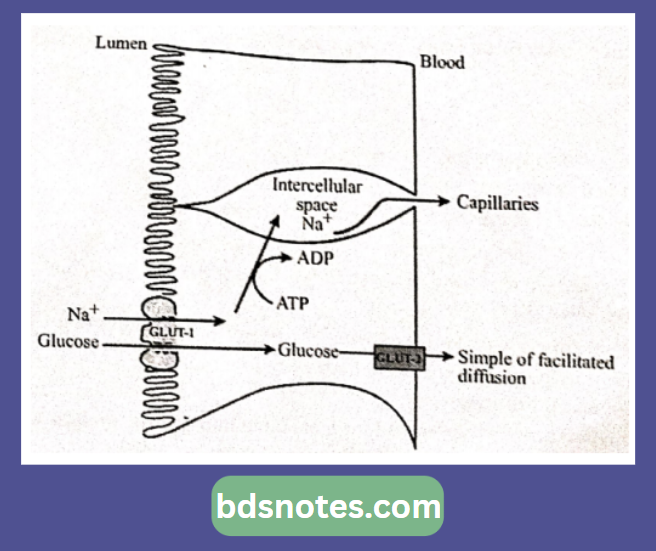
Absorption of glucose:
- Glucose is transported from the lumen of small intestine into the epithelial cells in the mucous membrane of small intestine by means of sodium co-transport.
- Glucose first combines with a ‘carrier’ and form glucose-carrier complex.
- This moves the glucose across the lipid barrier of cell membrane and releases the glucose inside the cell.
- The glucose and Na+ have the same carrier called sodium-dependent glucose transporter – 1.
- To concentrate the glucose within the cell, the carrier is coupled to a source of energy which is obtained by the binding process of sodium ion and the glucose molecule to the carrier protein.
- Sodium ion now moves laterally into the intercellular space utilizing the energy liberated by breakdown of ATP.
- The glucose is transported by glucose transporter – 2 into the interstitial space and then to blood capillaries.
“Common challenges in mastering carbohydrate digestion notes effectively: FAQs provided”
Factors effecting glucose absorption:
- Thyroid – increases absorption.
- Adrenal cortex deficiency – decreases absorption.
- In diarrhoea – absorption decreases.
Fate of glucose:
- 5% stored as glycogen in liver and muscle.
- 50-60%-catabolised in tissues.
- 30-40%-converted to fat and stored.
“Factors influencing success with carbohydrate digestion studies: Q&A”
“Steps to explain absorption of carbohydrates: Active transport vs facilitated diffusion: Q&A guide”
Leave a Reply