• Skip to main content
  • Skip to secondary menu
  • Skip to primary sidebar
  • About Us
  • Terms of Use
  • Privacy Policy
  • Disclaimer
  • Contact Us
  • Sitemap

BDS Notes

BDS notes, Question and Answers

  • Public Health Dentistry
  • Periodontics
  • Pharmacology
  • Pathology
  • Orthodontics
    • Anchorage In Orthodontics
    • Mandibular Growth, Functional Matrix
    • Retention and Relapse
  • General Surgery
    • Cysts: Types, Causes, Symptoms
    • Maxillofacial Fractures, Disorders, and Treatments
    • Lymphatic Disorders
    • Neurological and Facial Disorders
  • Temporal And Infratemporal Regions
    • Spinal and Neuroanatomy
  • Dental Materials
    • Dental Amalgam
Home » Histopathology of Calcifying Odontogenic Cyst (COC): A Microscopic View

Histopathology of Calcifying Odontogenic Cyst (COC): A Microscopic View

July 17, 2025 by Joankessler parkland Leave a Comment

Histopathology of Calcifying Odontogenic Cyst (COC): A Microscopic View

Question. Write a short note on the histopathology of COC.

Answer. It is also known as a calcifying odontogenic cyst or Calcifying epithelial odontogenic cyst.

“Understanding the role of histopathology in diagnosing COC: Q&A explained”

Histopathology Of COC

  • Epithelial lining of COC shows a prominent basal cell layer consisting of palisaded columnar or cuboidal cells and hyperchromatic nuclei, which are polarized away from the basement membrane.
  • Epithelium is 6–8 cell layers thick.
  • Budding from the basal cell layer into adjacent connective tissue and epithelial proliferations into the lumen are seen.

“Importance of studying histopathology of calcifying odontogenic cyst: Questions explained”
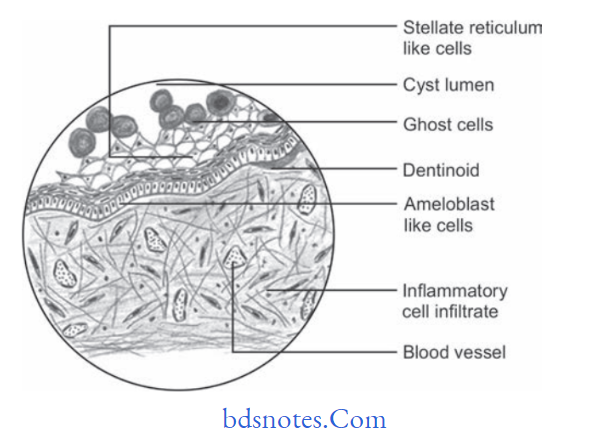
Cysts of Oral Cavity Calcifying odontogenic cyst

“Common challenges in identifying COC effectively: FAQs provided”

  • Ghost cells: They are enlarged, ballooned in shape, ovoid, or elongated elliptoid epithelial cells.
    They are eosinophilic.
    They are found in thick areas of the epithelial lining.
    Cell outlines of these cells are well defined and at times they may be blurred. They are seen singly and also present in groups.
    Few ghost cells also show nuclear remnants.
    Ghost cells have an abnormal type of keratinization and have an affinity for calcification.

“Factors influencing success with COC diagnosis: Q&A”

  • Ghost cells may also remain in contact with the connective tissue wall of the cyst, where they lead to foreign body reactions with the formation of multinucleated giant cells.
  • An atubular dentinoid is also seen in the wall close to the epithelial lining and is also concerning epithelial proliferation.
  • Dentinoids are found particularly in contact with masses of ghost cells.

Filed Under: Oral Pathology

Reader Interactions

Leave a Reply Cancel reply

Your email address will not be published. Required fields are marked *

Primary Sidebar

Recent Posts

  • Branchial Cleft Cyst: Background, Pathophysiology, Etiology
  • Maxillary Nerve: Origin, Course, And Branches
  • The Father Of Anatomy And A Great Anatomist Herophilus
  • Bone Structure – Anatomy
  • The External Carotid Artery: Anatomy, Branches, And Functions
  • Occipitofrontalis Muscle
  • Superficial Temporal Artery
  • Platysma Muscle
  • Cartilage
  • Cauda Equina And Conus Medullaris Syndromes
  • Subcutaneous Injections And Device Management
  • Types Of Circulation: Pulmonary, Systemic, And Portal
  • Structure Of Skeletal Muscle
  • Elastic Cartilage
  • Cellular Organelles And Structure
  • The Golgi Apparatus – The Cell
  • The Cytoplasmic Inclusions Of Certain Plant Cells
  • Dental Abscess
  • Laser Surgery
  • Our Facial Muscles And Their Functions

Copyright © 2026 · Magazine Pro on Genesis Framework · WordPress · Log in