• Skip to main content
  • Skip to secondary menu
  • Skip to primary sidebar
  • About Us
  • Terms of Use
  • Privacy Policy
  • Disclaimer
  • Contact Us
  • Sitemap

BDS Notes

BDS notes, Question and Answers

  • Public Health Dentistry
  • Periodontics
  • Pharmacology
  • Pathology
  • Orthodontics
    • Anchorage In Orthodontics
    • Mandibular Growth, Functional Matrix
    • Retention and Relapse
  • General Surgery
    • Cysts: Types, Causes, Symptoms
    • Maxillofacial Fractures, Disorders, and Treatments
    • Lymphatic Disorders
    • Neurological and Facial Disorders
  • Temporal And Infratemporal Regions
    • Spinal and Neuroanatomy
  • Dental Materials
    • Dental Amalgam
Home » Buccinator Mechanism

Buccinator Mechanism

July 26, 2025 by Kristensmith Taylor Leave a Comment

Buccinator Mechanism

Write short note on buccinator mechanism.
Or
Write short answer on buccinator mechanism.
Answer.

Buccinator Mechanism

It refers to the continuous band of muscles which surrounds the dentition and are tightly anchored at pharyngeal tubercle of occipital bone.

“Understanding the role of the buccinator mechanism in oral health”

  • Buccinator mechanism begins with decussating fibers of orbicularis muscle which joins the right as well as left fibers of lip. These constitutes anterior component of buccinator mechanism.
  • Buccinator mechanism then follows laterally and posteriorly at corner of mouth which joins other fibers of buccinators muscle which are inserted in pterygomandibular raphae.
  • At pterygomandibular raphae fibers of buccinators muscle interwind with fiers of superior constrictor muscle and run posteriorly and medially to fi with pharyngeal tubercle.
  • All muscles in buccinator mechanism act like a rubber band which tightly surrounds the mandible.

“Importance of studying the buccinator mechanism for better treatment outcomes”
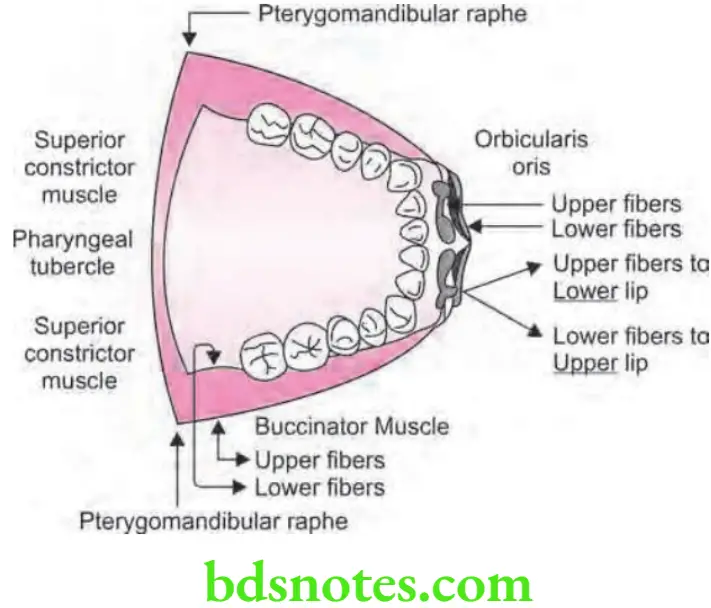
Orthodontics Functional Development Buccinator Mechanism

“Common challenges in diagnosing issues related to the buccinator mechanism”

Clinical Significance

  • Imbalance in buccinator mechanism causes malocclusion.
  • In oral habits such as thumb sucking, tongue thrusting balance between buccinators mechanism and tongue become lost which leads to open bite, increased proclination and constricted maxillary arch.

Filed Under: Orthodontics

Reader Interactions

Leave a Reply Cancel reply

Your email address will not be published. Required fields are marked *

Primary Sidebar

Recent Posts

  • Branchial Cleft Cyst: Background, Pathophysiology, Etiology
  • Maxillary Nerve: Origin, Course, And Branches
  • The Father Of Anatomy And A Great Anatomist Herophilus
  • Bone Structure – Anatomy
  • The External Carotid Artery: Anatomy, Branches, And Functions
  • Occipitofrontalis Muscle
  • Superficial Temporal Artery
  • Platysma Muscle
  • Cartilage
  • Cauda Equina And Conus Medullaris Syndromes
  • Subcutaneous Injections And Device Management
  • Types Of Circulation: Pulmonary, Systemic, And Portal
  • Hierarchical Organization Of Skeletal Muscle Tissue
  • Elastic Cartilage Histology Short Note For Medical Exams
  • Cellular Organelles And Structure
  • The Golgi Apparatus – The Cell
  • The Cytoplasmic Inclusions Of Certain Plant Cells
  • Dental Abscess
  • Laser Surgery
  • Our Facial Muscles And Their Functions

Copyright © 2026 · Magazine Pro on Genesis Framework · WordPress · Log in