• Skip to main content
  • Skip to secondary menu
  • Skip to primary sidebar
  • About Us
  • Terms of Use
  • Privacy Policy
  • Disclaimer
  • Contact Us
  • Sitemap

BDS Notes

BDS notes, Question and Answers

  • Public Health Dentistry
  • Periodontics
  • Pharmacology
  • Pathology
  • Orthodontics
    • Anchorage In Orthodontics
    • Mandibular Growth, Functional Matrix
    • Retention and Relapse
  • General Surgery
    • Cysts: Types, Causes, Symptoms
    • Maxillofacial Fractures, Disorders, and Treatments
    • Lymphatic Disorders
    • Neurological and Facial Disorders
  • Temporal And Infratemporal Regions
    • Spinal and Neuroanatomy
  • Dental Materials
    • Dental Amalgam
Home » Classification of Vitamins: Fat-Soluble and Water-Soluble Types Explained

Classification of Vitamins: Fat-Soluble and Water-Soluble Types Explained

August 24, 2023 by Tanuja Puram Leave a Comment

Classification of Vitamins: Fat-Soluble and Water-Soluble Types Explained

Classification of vitamins.
Answer.

“Factors influencing success with vitamin knowledge: Q&A”

Vitamins may be regarded as organic compounds required in the diet in small amounts to perform specific biological functions for the normal maintenance of optimum growth and health of the organism.

Although vitamins have little chemical similarities, their metabolic functions have been described as

  • Membrane stabilizers
  • Hydrogen and electro donor & acceptor
  • Hormones & coenzymes.

“Understanding vitamin classification through FAQs: Q&A explained”

Read And Learn More: BSc Nursing 1st Year Nutrition And Biochemistry Previous Year Question and Answers

Classification of vitamins
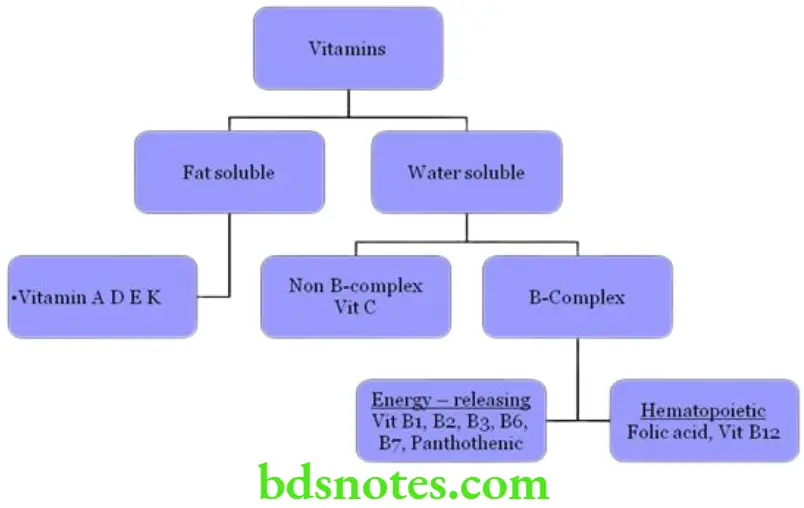
Nutrition And Biochemistry Vitamins Classification of vitamins

“Importance of studying vitamin classification for better health outcomes: Questions explained”

Fat-soluble vitamins

  • Vitamins A, D, E, and K are known as fat or lipid – soluble vitamins.
  • Their availability in the diet, absorption, and transport are associated with fat.
  • They are soluble in fats and oils, and also the fat solvents (alcohol, acetone, etc.)
  • They are stored in the liver and adipose tissue.
  • They are not readily excreted in urine. But with feces via the enterohepatic circulation
  • Excess consumption may lead to accumulation and toxic effects.

“Common challenges in understanding vitamin types effectively: FAQs provided”

Water-soluble vitamins

  • Heterogeneous group of compounds since they differ chemically from each other.
  • Common character – solubility in water.
  • Readily excreted in urine and not toxic to the body.
  • Not stored in large quantities in the body (except vitamin B12).
  • Stores are depleted within weeks, and deficiency symptoms result.
  • Hence needs to be continuously supplied through the diet.

Filed Under: Nutrition And Biochemistry

Reader Interactions

Leave a Reply Cancel reply

Your email address will not be published. Required fields are marked *

Primary Sidebar

Recent Posts

  • Branchial Cleft Cyst: Background, Pathophysiology, Etiology
  • Maxillary Nerve: Origin, Course, And Branches
  • The Father Of Anatomy And A Great Anatomist Herophilus
  • Bone Structure – Anatomy
  • The External Carotid Artery: Anatomy, Branches, And Functions
  • Occipitofrontalis Muscle
  • Superficial Temporal Artery
  • Platysma Muscle
  • Cartilage
  • Cauda Equina And Conus Medullaris Syndromes
  • Subcutaneous Injections And Device Management
  • Types Of Circulation: Pulmonary, Systemic, And Portal
  • Hierarchical Organization Of Skeletal Muscle Tissue
  • Elastic Cartilage Histology Short Note For Medical Exams
  • Cellular Organelles And Structure
  • The Golgi Apparatus – The Cell
  • The Cytoplasmic Inclusions Of Certain Plant Cells
  • Dental Abscess
  • Laser Surgery
  • Our Facial Muscles And Their Functions

Copyright © 2026 · Magazine Pro on Genesis Framework · WordPress · Log in