Bionator
Write short note on Bionator.
Answer. Bionator is a myofunctional appliance.
- Bionator was developed by “Wilham Balters“.
- Bionator is less bulky than activator and can be worn all the time except during meals.
“Understanding the role of the Bionator in correcting malocclusions”
Philosophy of Bionator
According to “BaIters”:
The equilibrium between the tongue and the circumoral muscle is responsible for the shape of the dental arches and intercuspation.
- He also said that position of tongue causes certain type of malocclusion.
- Posterior displacement causes class 2 malocclusion while anterior displacement causes class 3 malocclusion.
- The principle of bionator is not to activate the muscles but to modulate muscle activity, thereby enhancing the normal development of the inherent growth pattern.
“Importance of studying the Bionator for better orthodontic outcomes”
Types of Bionators
- Standard appliance: It corrects Class 2 division 1 malocclusion.
- Screening appliance: Eliminates abnormal tongue movements in open bite cases.
- Reverse appliance: Treats Class 3 malocclusion.
Fabrication
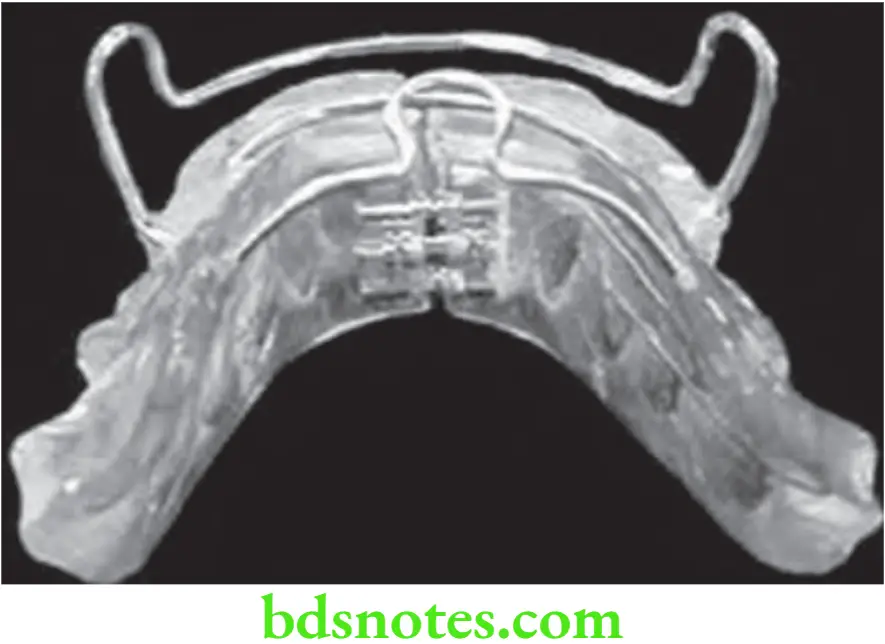
Bionator consists of two components, i.e. acrylic component and wire component.
“Common challenges in using the Bionator effectively”
Acrylic Component
- Thickness of acrylic block should be minimum and thickness should not reach over tongue space.
- Acrylic begins from distal part of maxillary canine to 2mm behind distal aspect of fist molar.
- Only 2 to 3 mm of mucosa should be covered at above gingival margins of maxillary and mandibular teeth buccally.
- Joining of upper and lower part is done by interocclusal acrylic block which extends to half the area of occlusal surface of teeth.
Wire Component
- Palatal Arch
- Made up of 1.2 mm wire.
- Origin is near to upper canine.
- From upper canine it moves vertically to palatal vault.
- As it moves it join a line at center of fist premolar or deciduous fist molar and turns at distal aspect forming a loop.
- Extension is till the distal aspect of fist molar.
- The loop formed is of egg shape, horizontal and lie 1mm above the mucosa.
- Loop should follow contours of palate.
- This arch cannot be activated.
“Steps to explain the design of the Bionator appliance”
- Vestibular Arch
- Made up of 0.9 mm wire.
- Labial portion of arch should be shaped so that it should not touch the surface of incisor teeth.
- Distal to lateral incisor wire should bend downward and distal for forming buccinator loop.
- Buccinator loop prevent pressure of cheek to act over buccal segment which leads to passive expansion of arch.
- Extension of buccinators loop is till the embrasure in between deciduous second molar and permanent first molar in upper arch.
- Here it forms a 90° round bend and run from all the crowns to embrasure between canine and deciduous first molar or fist premolar.
- At deciduous fist molar or premolar it is merged to acrylic.
“Role of acrylic and wire components in the Bionator”
Bionator Management
- It is weared in both day and night and should be removed during meals.
- Time interval between appointments is 3 to 4 weeks.
Bionator Indications
- In class 2 division 1 malocclusion because of retruded mandible.
- In class 3 malocclusion
- In open bite due to functional causes.
“Early warning signs of poor Bionator fit or function”
Bionator Contraindications
- Class 2 relationship due to maxillary prognathism.
- In vertical growth pattern.
- In labially tipped lower incisors.
- In anterior crowding.
Bionator Advantages
- Appliance is less bulky.
- Can be worn full time except during meals.
- Appliance exerts a constant inflence on the tongue and perioral muscles.
Bionator Disadvantage
Difficulty in correct managing of appliance.
“Asymptomatic vs symptomatic effects of improper Bionator use”
Leave a Reply