• Skip to main content
  • Skip to secondary menu
  • Skip to primary sidebar
  • About Us
  • Terms of Use
  • Privacy Policy
  • Disclaimer
  • Contact Us
  • Sitemap

BDS Notes

BDS notes, Question and Answers

  • Public Health Dentistry
  • Periodontics
  • Pharmacology
  • Pathology
  • Orthodontics
    • Anchorage In Orthodontics
    • Mandibular Growth, Functional Matrix
    • Retention and Relapse
  • General Surgery
    • Cysts: Types, Causes, Symptoms
    • Maxillofacial Fractures, Disorders, and Treatments
    • Lymphatic Disorders
    • Neurological and Facial Disorders
  • Temporal And Infratemporal Regions
    • Spinal and Neuroanatomy
  • Dental Materials
    • Dental Amalgam
Home » Axillary Vein

Axillary Vein

October 26, 2025 by Joankessler parkland Leave a Comment

Axillary Vein

Question 1. Describe the axillary vein briefly.
Answer.

Axillary Vein Source and extent

  • Axillary Vein begins at the lower border of the teres major by the union of the basilic vein and the venae comitantes of the brachial artery.
  • Axillary Vein runs upwards and medially to continue as the subclavian vein at the outer border of the 1st rib.

“Understanding the axillary vein through FAQs: Anatomy, functions, and uses explained”

Axillary Vein Lymph Nodes Anatomy

“Importance of studying the axillary vein for medical students: Questions explained”

Axillary Vein  Tributaries

  • Veins corresponding to the branches of the axillary artery, i.e., lateral thoracic, subscapular, etc.
  • Cephalic vein.

Axillary Vein  Applied Anatomy

Spontaneous thrombosis of the axillary vein may occasionally occur following unaccustomed movements of the arm at the shoulder joint.

Question 5. Describe the arterial anastomosis around scapula.
Answer.

The arterial anastomosis around the scapula is formed between the branches of the first part of the subclavian artery and the branches of the third part of the axillary artery.

“Common challenges in mastering axillary vein notes effectively: FAQs provided”
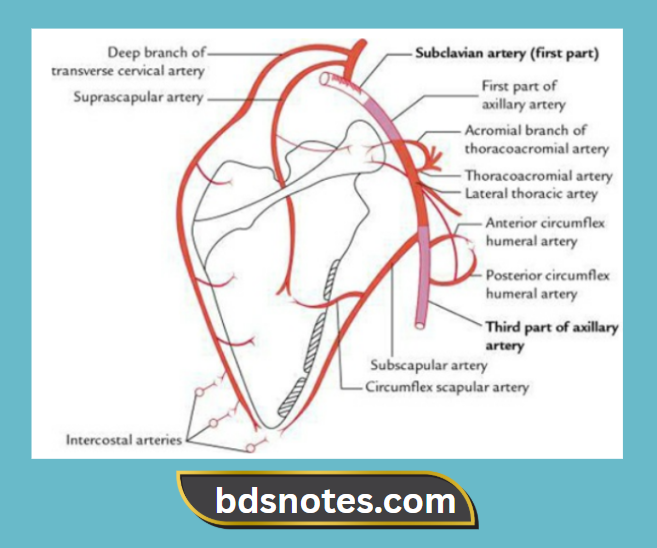
Pectoral Region Axilla Arterial Anastomosis

“Factors influencing success with axillary vein studies: Q&A”

The following branches from the first part of the subclavian artery and the third part of the axillary artery take part in this anastomosis:

Arterial Anastomosis: Clinical Importance

This anastomosis around the scapula provides collateral channels to ensure adequate circulation to the upper limb in case the subclavian artery or axillary artery is blocked anywhere between the first part of the subclavian artery and the third part of the axillary artery.

Filed Under: Upper Limb

Reader Interactions

Leave a Reply Cancel reply

Your email address will not be published. Required fields are marked *

Primary Sidebar

Recent Posts

  • Branchial Cleft Cyst: Background, Pathophysiology, Etiology
  • Maxillary Nerve: Origin, Course, And Branches
  • The Father Of Anatomy And A Great Anatomist Herophilus
  • Bone Structure – Anatomy
  • The External Carotid Artery: Anatomy, Branches, And Functions
  • Occipitofrontalis Muscle
  • Superficial Temporal Artery
  • Platysma Muscle
  • Cartilage
  • Cauda Equina And Conus Medullaris Syndromes
  • Subcutaneous Injections And Device Management
  • Types Of Circulation: Pulmonary, Systemic, And Portal
  • Structure Of Skeletal Muscle
  • Elastic Cartilage
  • Cellular Organelles And Structure
  • The Golgi Apparatus – The Cell
  • The Cytoplasmic Inclusions Of Certain Plant Cells
  • Dental Abscess
  • Laser Surgery
  • Our Facial Muscles And Their Functions

Copyright © 2026 · Magazine Pro on Genesis Framework · WordPress · Log in