Anatomy, Head, And Neck: Atlantoaxial Joint
Describe the Atlantoaxial Joints in brief.
Answer.
Atlantoaxial Joints
“Importance of studying the atlantoaxial joint for medical students: Questions explained”
These are three in number: median atlantoaxial joint and right and left lateral atlantoaxial joints.
Atlantoaxial Joints Classification
- Median atlantoaxial joint: Pivot type of synovial joint
- Lateral atlantoaxial joint: Plane type of synovial joint
“Understanding the anatomy of the atlantoaxial joint through FAQs: Q&A explained”
Atlantoaxial Joints Articular Surfaces And Ligaments
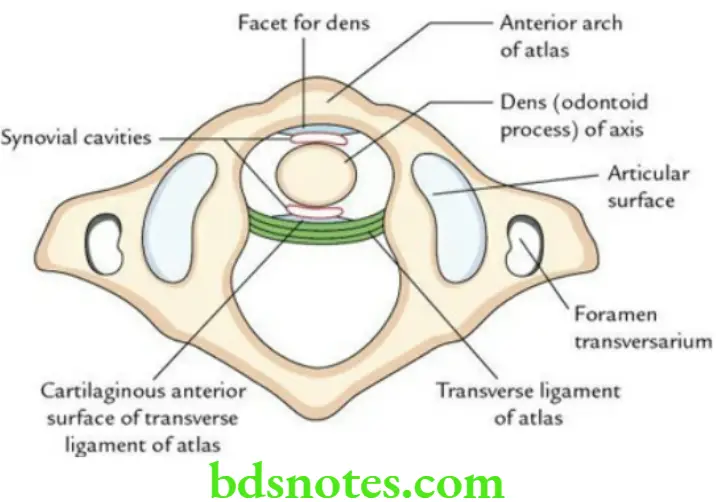
- Median Atlantoaxial Joint: It is formed between the dens of axis and the anterior arch of the atlas. The articular facet on the anterior aspect of dens articulates with the facet on the posterior surface of the anterior arch of atlas. Posteriorly between the base of dens of axis and transverse ligament of atlas lies a synovial bursa. It is a pivot type of synovial joint.
- Lateral Atlanto-axial Joints: It is formed between the superior articular facet of axis and inferior articular facet of atlas. It is a plane type of synovial joint.
“Common challenges in understanding atlantoaxial joint anatomy effectively: FAQs provided”
“Factors influencing success with atlantoaxial joint knowledge: Q&A”
Atlantoaxial Joints Movements
The atlanto-occipital joints are responsible for rotation of the head. They permit the head to be turned from side-to-side, e.g. when rotating the head to indicate disapproval. Hence, these movements are also called ‘no movements’.
Leave a Reply