Antibodies Or Immunoglobulins
Question 1. Write in brief about immunoglobulin.
Or
Write a short note on immunoglobulins.
Answer:
Immunoglobulin is defined as a protein of animal origin endowed with known antibody activity and other related proteins. Immunoglobulins are the group of glycoproteins that are present in the serum and tissue fluids of all mammals. Immunoglobulin is synthesized by plasma cells and also by lymphocytes in response to foreign substances.
“Early warning signs of gaps in understanding antibody basics: Common questions”
Characteristics of Immunoglobulins
- Antibodies are globulins and so are known as immunoglobulins.
- Immunoglobulins consist of sugar residues, so they are glycoproteins.
- Immunoglobulins consist of 20 to 25% of total serum proteins.
- When these are separated, most of them migrate in the gamma region, so they are known as gamma globulin.
- Most of the immunoglobulins have a molecular weight of 1,50,000 to 1,80,000 and a sedimentation coefficient of 7S to 8S except for IgM. IgM has a molecular weight of 9,00,000 and a sedimentation coefficient of 19S and is known as a macroglobulin.
- Immunoglobulins are thermolabile and denatured on heating at 70 °C for 1 hour.
- All antibodies are immunoglobulin but all immunoglobulin are not antibodies.
“Understanding antibodies through FAQs: Q&A explained”
Read And Learn More: Microbiology Question And Answers
Functions of Immunoglobulins
- Complement activation causes lysis.
- Opsonization results in phagocytosis.
- Prevention of attachment of a microbe to the host cells.
- Neutralize toxins.
- The motility of microorganisms is restricted.
“Role of antigen-binding sites in antibody specificity: Questions answered”
Classes of Immunoglobulins
- IgG: It is the major serum immunoglobulin, consisting of 80% of total immunoglobulins, and is distributed equally to intravascular and extravascular compartments. It passes through the placenta and provides passive immunity to the newborn. It produces passive cutaneous anaphylaxis.
- IgA: It is the fast-moving alpha globulin and is the second most abundant class of immunoglobulins. It occurs in two forms, i.e. serum IgA and secretory IgA.
It is found in high concentration in colostrum, tear, bile, saliva, intestinal and nasal secretion. Its amount is greatly increased in cases of multiple myeloma. It promotes phagocytosis and
intracellular killing of organisms. - IgM: It is also called as a macroglobulin. Mostly it is intravascular. It appears to be spherical in shape. IgM appears on the surface of stimulated B lymphocytes and acts as a recognition receptor for antigens.
This immunoglobulin does not cross the placenta, so its detection in fetuses and newborns is suggestive of intrauterine infections, i.e. syphilis, rubella, HIV, and toxoplasmosis. - IgD: It is mostly intravascular. IgD may function as a mutually interacting antigen receptor for the control of leucocyte activation and suppression.
- IgE: It is a regaining antibody responsible for the immediate hypersensitive reaction. It has an affinity for the surface of tissue cells, i.e. mast cells, and mediates the Prausnit Kustner reaction. It is secreted in the linings of respiratory and intestinal tracts.
- Elevated levels are seen in atopic conditions like asthma, hay fever, and eczema. It provides protection against pathogens by the release of inflammatory mediators via mast cell degranulation. It also provides defense against infection produced by helminths.
“Importance of studying antibodies for biology and medical students: Questions explained”
Question 2. Write a short note on IgM: Structure and Function.
Answer:
IgM is also known as immunoglobulin M.
Structure of IgM
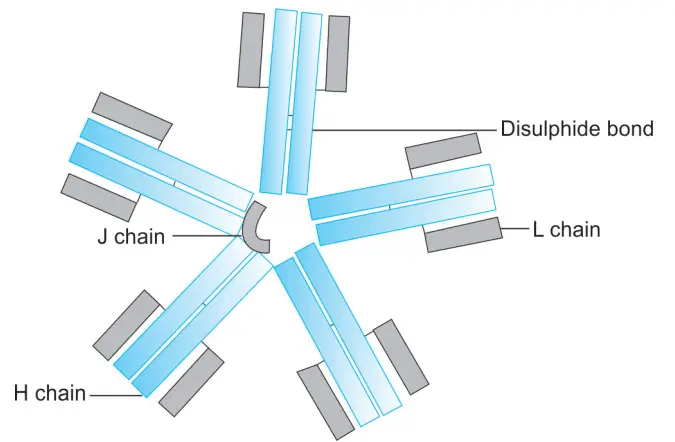
- IgM is a pentamer and has five immunoglobulin subunits and one molecule of the J chain which joins the Fc region of basic
subunits. - Each H chain of IgM has four CH domains rather than three as seen H chain of IgG molecule.
- IgM molecule is heavy with a molecular weight of 9 lakhs to 10 lakhs. It is also known as a millionaire molecule.
- It has 5-8% of total serum immunoglobulins. The normal level
in serum is 0.5-2 mg/m - The valency of IgM is 10 which is observed on interactions with small haptens only. With larger antigens effective valency is 5.
“Steps to explain antibody structure: Heavy chains vs light chains: Q&A guide”
“Common challenges in understanding antibodies effectively: FAQs provided”
Function of IgM
- It appears early in response to infection before IgG. So its presence in serum indicates early infection.
- IgM antibody does not cross the placenta, the presence of IgM in the serum of neonates indicates congenital infection. Helps in the diagnosis of congenital syphilis, HIV, toxoplasmosis, and rubella.
- Since IgM is the most effective antibody in agglutination, complement fixation, and opsonization, it initiates
complement cascade and target cell lysis with a single molecule. - IgM provide protection against blood invasion by microorganisms. Deficiency of IgM leads to bacteremia
and septicemia. - IgM appears on the surface of unstimulated B lymphocytes and acts as a recognition receptor for antigens.
- IgM is complemented by the classical pathway.
Leave a Reply