• Skip to main content
  • Skip to secondary menu
  • Skip to primary sidebar
  • About Us
  • Terms of Use
  • Privacy Policy
  • Disclaimer
  • Contact Us
  • Sitemap

BDS Notes

BDS notes, Question and Answers

  • Public Health Dentistry
  • Periodontics
  • Pharmacology
  • Pathology
  • Orthodontics
    • Anchorage In Orthodontics
    • Mandibular Growth, Functional Matrix
    • Retention and Relapse
  • General Surgery
    • Cysts: Types, Causes, Symptoms
    • Maxillofacial Fractures, Disorders, and Treatments
    • Lymphatic Disorders
    • Neurological and Facial Disorders
  • Temporal And Infratemporal Regions
    • Spinal and Neuroanatomy
  • Dental Materials
    • Dental Amalgam
Home » Antianginal And Other Anti-Ischemic Drugs Question And Answers

Antianginal And Other Anti-Ischemic Drugs Question And Answers

May 15, 2023 by Kristensmith Taylor Leave a Comment

Antianginal And Other Anti-Ischemic Drugs Question And Answers

Question 1. Give The Pharmacological Explanation For Why Nitroglycerine Tablet May Not Be Effective When Swallowed, But Works Very Well For Patient Of Angina Pectoris When Kept Under The Tongue?
Or
Explain Why Nitroglycerin Is Used Sublingually In The Treatment Of an Acute Attack Of Angina Pectoris.
Answer:

Nitroglycerine has a very high first-pass metabolism. So the drug achieves a low plasma concentration when given orally. Thus, its bioavailability is less through the oral route. To circumvent this drug is administered by the sublingual route.

Through the sublingual route drug directly reaches the blood vessel and has a faster onset of action to stop an acute attack of angina.

Antianginal Drugs: Mechanism, Uses, and Side Effects

“Importance of studying antianginal drugs for healthcare professionals”

Read And Learn More: Pharmacology Question And Answers

Self-administration of drugs is possible by sublingual route.
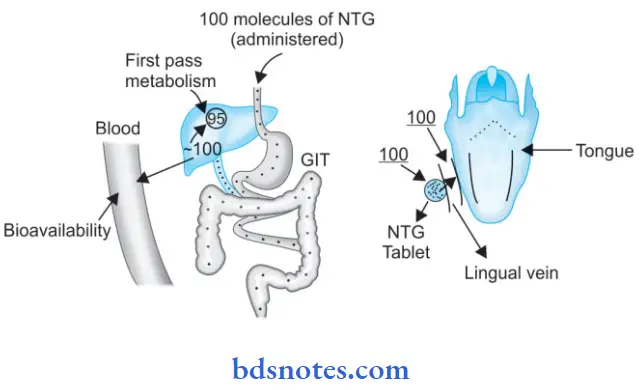
Antianginal And Other Anti-Ischemic Drugs Diagram Showing Comparison Of Oral And Sublingual Administration Of Nitroglycerine

“Understanding the role of antianginal drugs in treating ischemic heart disease”

Mechanism Of Action

Nitrates cause smooth muscle relaxation of veins and cause peripheral pooling of blood and reduce venous return, decrease preload, end-diastolic size, and pressure is decreased due to which cardiac work is reduced.

Anti-Ischemic Drugs: Treatment Options and Dosage
Antianginal And Other Anti-Ischemic Drugs Question And Answers

“Techniques for managing high-risk groups with ischemic heart disease”

Question 2. Explain why β-blockers are Not Used In Stable Angina Pectoris.
Answer:

β-blockers exacerbate stable angina due to unopposed α-mediated coronary constriction that may accentuate coronary spasm. That’s why they are not used in stable angina patients.

Filed Under: Pharmacology

Reader Interactions

Leave a Reply Cancel reply

Your email address will not be published. Required fields are marked *

Primary Sidebar

Recent Posts

  • Branchial Cleft Cyst: Background, Pathophysiology, Etiology
  • Maxillary Nerve: Origin, Course, And Branches
  • The Father Of Anatomy And A Great Anatomist Herophilus
  • Bone Structure – Anatomy
  • The External Carotid Artery: Anatomy, Branches, And Functions
  • Occipitofrontalis Muscle
  • Superficial Temporal Artery
  • Platysma Muscle
  • Cartilage
  • Cauda Equina And Conus Medullaris Syndromes
  • Subcutaneous Injections And Device Management
  • Types Of Circulation: Pulmonary, Systemic, And Portal
  • Structure Of Skeletal Muscle
  • Elastic Cartilage
  • Cellular Organelles And Structure
  • The Golgi Apparatus – The Cell
  • The Cytoplasmic Inclusions Of Certain Plant Cells
  • Dental Abscess
  • Laser Surgery
  • Our Facial Muscles And Their Functions

Copyright © 2026 · Magazine Pro on Genesis Framework · WordPress · Log in