Anterior Open Bite: Etiology, Clinical Features, And Treatment
Give etiology and treatment modalities of anterior open bite.
Answer. Anterior open bite is a condition where there is no vertical overlap between upper and lower anterior.
Classification of anterior open bite
It is classified as:
- Skeletal anterior open bite: Open bite which develops due to the excessive vertical growth.
- Dental anterior open bite: They may close spontaneously in growing patient and are generally amenable to orthodontic treatment.
Etiology
- Digit sucking habits: Prolonged thumb sucking leads to open bite. A typical thumb sucker has malocclusion characterized by an asymmetric anterior open bite because of digit position and transverse constriction of maxillary arch due to lowered tongue posture. Thumb or a figer acts as a barrier and prevent the eruption of incisors and during same time allowing excessive eruption of posterior teeth.
- Lip and tongue habits: Habitual tongue thrusting leads to proclination and flring of upper anterior which causes anterior open bite.
- Airway obstruction: the most important factor is nasopharyngeal airway obstruction and the associated mouth breathing. Facial appearance of such patient is referred to as adenoid facies. In these, cheeks and nostrils are narrow, nostrils are pinched, lips are separated and there is exaggerated shadow beneath the eyes. They also have protruding teeth, an open mouth and dull expression.
- Skeletal growth abnormality: Various inherited factors such as size of tongue, abnormal skeletal growth pattern of maxilla and mandible leads to open bite. Genetic as well as the environmental factors which encourage the vertical growth in molar region are not compensated by growth at condyle or posterior ramus, this leads to anterior open bite.
- Iatrogenic causes: This is due to poor mechanics during fied appliance treatment which leads to extrusion of molar teeth or hanging palatal cusps, which opens the bite.
- Pathological causes: The causes are clef lip and palate, acromegaly or trauma to facial skeleton i.e. condylar fractures or Le Fort fractures of maxilla.
- Muscular dystrophy: Decrease in the tonic muscle activity which occur in the muscular dystrophy allow the mandible to rotate downward which lead to increase in anterior facial height, posterior growth rotation of mandible, excessive eruption posterior teeth, narrowing of maxillary arch and anterior open bite.
Clinical Features of Anterior Open Bite
Clinical Features of Skeletal Anterior Open Bite
- Increase in the lower anterior facial height.
- Increase in anterior and decrease in posterior facial height.
- Presence of steep mandibular plane angle.
- Patient often have long and the narrow face.
- Patient can have short upper lip with the excessive maxillary incisor exposure.
- Patient tends to have Class 2 malocclusion and mandibular deficiency.
- In some of the cases, upward tipping of maxillary skeletal base is observed.
Clinical Features of Dental Anterior Open Bit
- Maxillary anterior teeth are proclined.
- Patient may have narrow maxillary arch due to lowered tongue posture.
- Spacing may be seen in maxillary and mandibular anterior arches.
Cephalometric Features of Anterior Open Bite
- It reveals downward and backward rotation of mandible.
- Presence of upward tipping of maxillary skeletal base.
- Vertical maxillary increase is present.
- Presence of steep palatal plane and increased percentage of lower facial height.
- Excessive eruption of maxillary posterior teeth.
- Excessive eruption of maxillary and mandibular incisors.
- Cephalometric planes are divergent.
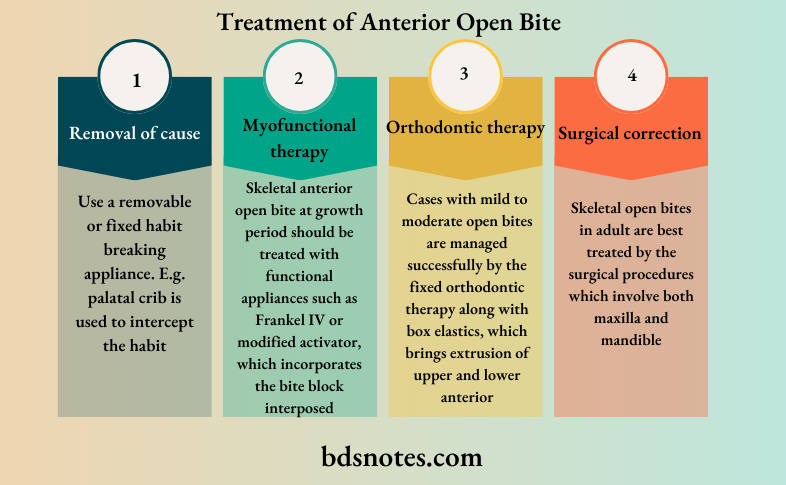
Treatment of Anterior Open Bite
Leave a Reply