Anemia
Question. Define and classify anemia. Describe iron deficiency anemia.
Or
Write in detail on iron deficiency anemia.
Or
Write a short note on iron deficiency anemia.
Or
Define anemia. Describe iron deficiency anemia in detail.
Answer. Anemia is defined as an abnormal reduction in several circulating red blood cells, quantity of hemoglobin, and the volume of packed red cells in a given unit of blood.
anemia
“Chronic diseases leading to anemia”
Classification of Anemia
Etiological classification of anemia (By Lea and Febiger, 1981)
- Loss of blood
- Acute posthemorrhagic anemia
- Chronic posthemorrhagic anemia.
- Excessive destruction of red blood corpuscles
- Extracorpuscular causes
- Antibodies
- Infections like malaria
- Splenic sequestration and destruction
- Associated diseases like lymphomas
- Drugs, chemical and physical agents
- Trauma to RBC.
- Extracorpuscular causes
- Intracorpuscular hemolytic diseases
- Hereditary
- Disorders of glycolysis
- Faulty synthesis or maintenance of reduced glutathione.
- Qualitative or quantitative abnormalities in the synthesis of globulin
- Abnormalities in the RBC membrane
- Erythropoietic porphyria
- Acquired
- Paroxysmal nocturnal hemoglobinuria
- Lead poisoning.
- Hereditary
- Impaired blood production resulting from a deficiency of substances essential for erythropoiesis
- Iron deficiency
- Deficiency of various B vitamins: Vitamin B12 and folic acid (pernicious anemia and megaloblastic anemia); pyridoxine-responsive anemia
- Protein deficiency
- Possibly ascorbic acid deficiency
- Inadequate production of mature erythrocytes
- Deficiency of erythroblasts
- Atrophy of bone marrow: Aplastic anemia
- Chemical or physical agents
- Hereditary
- Idiopathic.
- Isolated erythroblastopenia
- Thymoma
- Chemical agents
- Antibodies.
- Atrophy of bone marrow: Aplastic anemia
- Infiltration of bone marrow
- Leukemia, lymphomas
- Multiple myeloma
- Carcinoma, Sarcoma
- Myelofibrosis.
- Endocrine abnormalities
- Myxedema
- Addison’s disease
- Pituitary insufficiency
- Sometimes hyperthyroidism.
- Chronic renal failure
- Chronic inflammatory disease
- Infectious
- Deficiency of erythroblasts
symptoms of anemia
Noninfectious, including granulomatous and collagen disease.
“Understanding aplastic anemia: causes and symptoms”
Cirrhosis of the liver.
Morphological Classification of Anemia
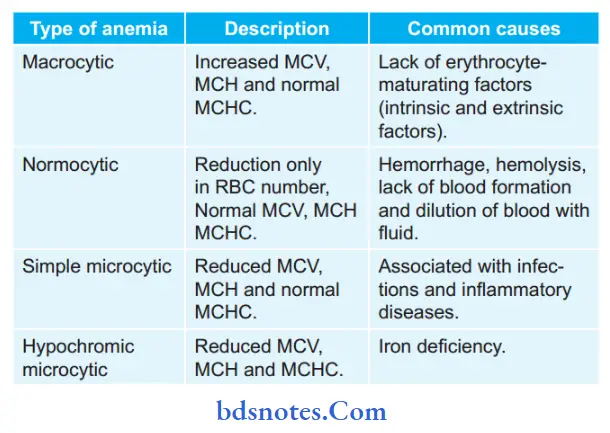
MCV = Mean corpuscular volume
MCH = Mean corpuscular hemoglobin
MCHC = Mean corpuscular hemoglobin concentration.
“Hemolytic anemia explained: types and treatments”
Iron Deficiency Anemia
Iron deficiency anemia results due to a deficiency of iron in the body.
Etiology
- Exogenous Cause: It is due to dietary deficiency
- Endogenous Cause:
- Absorption Defect as occurs in.
- Histamine, i.e. fast achlorhydria.
- Gastric operations, i.e. total gastrectomy and partial gastrectomy.
- Eterogeneous:
- Unusual hurry in the passage of chyme.
- Abnormality in absorbing mucosa.
- Transport Defect, i.e. atransferrinemia.
- Loss in Iron from Body:
- Loss due to hemorrhage in peptic ulcer, hiatus hernia, Ca stomach, Ca colon and hookworm manifestation.
- Excessive menstrual bleeding.
- Excessive excretion.
- Increased Requirement of Iron in pregnancy and lactation.
- Absorption Defect as occurs in.
“Most common type of anemia worldwide”
Clinical Features
- Females are more commonly affected during 4th and 5th decades.
- Patient complains of lack of concentration, tiredness,headache, presence of tingling sensations over extremities.
- Nails of the patient become britte and nail bed becomes spoon shaped which is also known as koilonychia.
- Patients feel difficulty in swallowing. This is also termed as dysphagia.
- Pigmentation can be seen over the dorsum of hand and metacarpophalangeal joint which is also known as knuckle pigmentation.
- Plummer-Vinson syndrome is associated with iron defi ciency anemia and other features are dysphagia, koilonychia and glossitis.
“Fatigue and weakness in anemia explained”
Oral Manifestations
- Presence of pallor of oral mucosa as well as gingiva.
- Atrophy of oral mucosa is present. This is seen on tongue and buccal mucosa.
- Glossodynia, i.e. pain in the tongue and glossopyrosis, i.e.reddening of tongue is present.
- Atrophy of filiform and fungiform papillae is present giving tongue a bald or smooth or glistening appearance.
- Presence of cracking and fisuring is seen at corner of mouth suggestive of angular cheilitis.
- At times aphthous ulcers are also seen.
“Early signs of anemia in adults”
Laboratory Diagnosis
- Examination of peripheral blood picture shows:
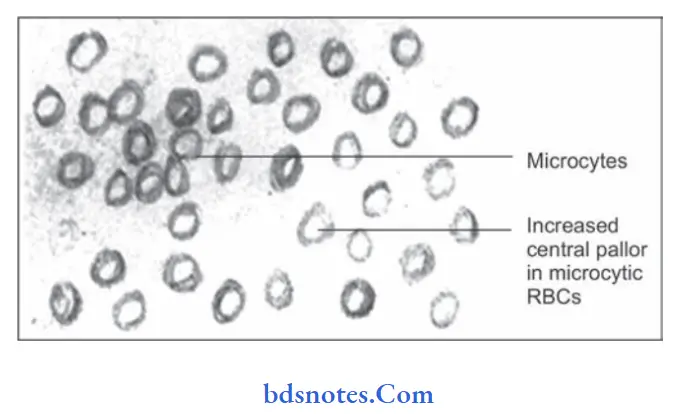
- Chromicity: Hypochromia of RBC
- Central pallor increased
- Anisochromia present
- Size: Microcytic anisocytotic
- Shape: Poikilocytosis often present, pear shaped tailed variety of RBC, elliptical form common.
- Target cell: Present
- Reticulocytes: Present
- Osmotic fragility: Slightly decreased
- ESR: Seldom elevated
- Chromicity: Hypochromia of RBC
- RBC count is between 3,000,000 to 4,000,000 cells per cubic mm of blood.
- Presence of low serum iron and ferritin with an elevated total iron binding capacity.
- Hemoglobin level is at 4 mg/dL or below it.
- MCV, MCH, and MCHC are decreased.
“Symptoms of anemia in children”
Treatment
- The patient should be kept on oral iron therapy. Ferrous fumarate or ferrous sulfate should be given to the patient.
300 mg tablet should be given 3 to 4 times a day for a six-month duration.
Leave a Reply