Anatomy Of The Temporomandibular Joint
Enumerate the ligaments and functions of TMJ.
Answer:
Ligaments:
1. Fibrous capsule:
- Attached above to the articular tubercle, mandibular fossa, and below to the neck of the mandible.
2. Lateral/temporomandibular ligament:
- Attached above to the articular tubercle.
- Below to the posterolateral aspect of the neck of the mandible.
- It reinforces and strengthens the capsular ligament.
“Understanding the TMJ through FAQs: Structure, functions, and uses explained”
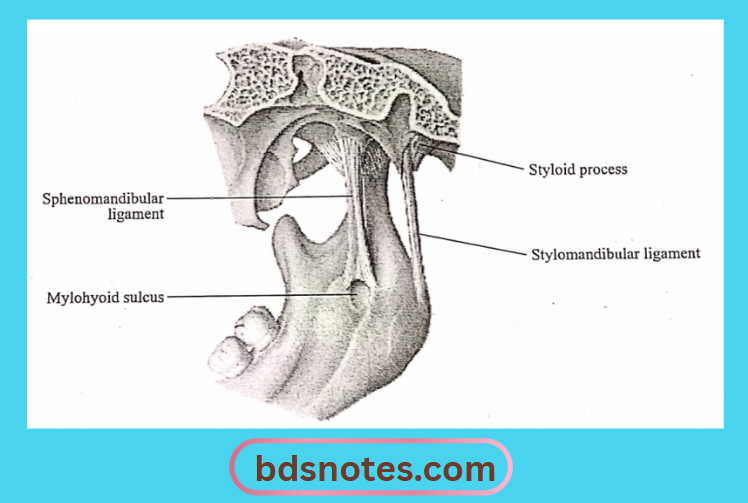
3. Sphenomandibular ligament:
- It is an accessory ligament.
- It arises from the spine of the sphenoid and from the petrotympanic fissures and ends at the lingula of the mandible.
- It is a remnant of Meckel’s cartilage.
4. Stylomandibular ligament:
- It is also an accessory ligament.
- It is attached above the lateral surface of the styloid process and below to the angle and ramus of the mandible.

“Importance of studying TMJ anatomy for dental students: Questions explained”
“Common challenges in mastering TMJ anatomy notes effectively: FAQs provided”
5. Otomandibular ligaments:
- These are discomalleolar and tympano mandibular ligaments.
- They connect callers to the TMJ disk and to the sphenomandibular ligaments.
Temporomandibular Joints Functions:
1. Protraction/forward movement of the mandible.
- During this movement the articular disc of the TMJ glides forward over the upper articular surface, the head of the mandible moving with it.
2. Retraction of mandible:
- During this, the articular disc glides backward over the upper articular surface.
“Factors influencing success with TMJ studies: Q&A”
3. Slight opening of the mouth.
- The head of the mandible moves on the undersurface of the disc.
4. Wide opening of the mouth.
- It is followed by protraction.
5. Chewing movements/side-to-side movements of the mandible.
Leave a Reply