Aims And Scope Of Orthodontics
Define orthodontics. Discuss in detail the Jackson triad and the scope of orthodontics.
Answer.
Answer.
“Understanding the role of orthodontics in modern dentistry”
In 1911, Noyes gave the first definition of orthodontics as “The study of the relation of the teeth to the development of the face and the correction of arrested and perverted development.”
In 1922, The British Society of Orthodontists proposed that, “Orthodontics includes the study of growth and development of jaws and face particularly and the body generally, as influencing the position of the teeth; the study of action and reaction of internal and external influences on the development, and the prevention and correction of arrested and perverted development”.
“Importance of studying the aims and scope of orthodontic care”
Aims and scope of orthodontics
Later, the American Board of Orthodontics (ABO) and the American Association of Orthodontists (AAO) stated that, “Orthodontics is that specific area of dental practice that has its responsibility, the study and supervision of the growth and development of the dentition and its related anatomical structures from birth to dental maturity, including all preventive and corrective procedures of dental irregularities, requiring the repositioning of teeth by functional or mechanical means to establish normal occlusion and pleasing facial contours.”
“Common challenges in achieving orthodontic goals”
Jackson Triad
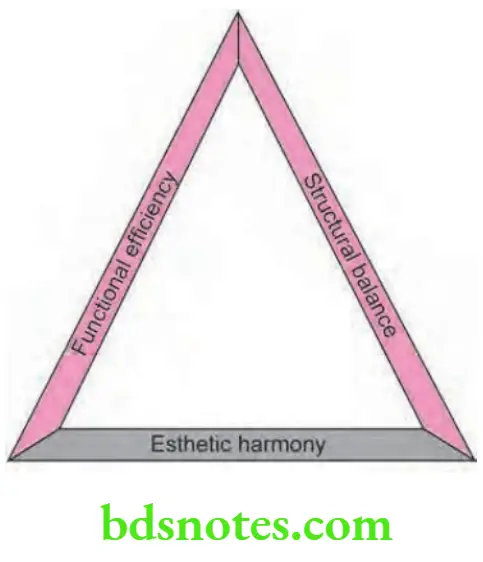
Jackson has summarized the aims of orthodontic treatment that are popularly known as Jackson’s Triad. They are:
- Functional efficiency
- Structural balance
- Aesthetic harmony.
Functional Efficiency
The teet,h along with their surrounding structures are required to perform certain significant functions such as mastication and phonation. Orthodontic treatment should increase the efficiency of the functions performed.
“Steps to explain the primary aims of orthodontic treatment”
Structural Balance
Orthodontic treatment not only affects teeth but also the soft tissue envelop and the associated skeletal structures. The treatment should maintain a balance between these structures and the correction of one should not affect the health of the other.
“Role of orthodontics in improving facial harmony and function”
Esthetic Harmony
Orthodontic treatment should enhance the overall esthetic appeal of the individual. This might just require the alignment of certain teeth or movement of the complete dental arch, including its basal bone. The aim is to get results which go well with the patient’s personality and make him or her look more esthetically appealing.
Scope of Orthodontics
Orthodontic treatment involves the three main tissue systems concerned in dentofacial development, namely the dentition, the skeleton and the facial and jaw musculature. Orthodontic treatment can bring about changes in the dentition, the skeletal system and the enveloping sof tissue.
“Early warning signs of untreated conditions orthodontics can correct”
Alteration in Tooth Position
Orthodontic treatment is made possible by the fact that teeth can be moved through the bone to ideal locations by applying appropriate force on them.
Most malocclusions involving the dental system can be effectively treated by moving teeth to normalize the occlusion.
Purpose of orthodontic treatment
Alteration in Skeletal Pattern
Malocclusion may be associated with skeletal disharmony involving the jaw bones (i.e. maxilla and mandible). Deviations from the normal can arise in size, position, and relationship between these skeletal components. It is within the scope of an orthodontist to apply appropriate orthopedic forces that are capable of restraining, promoting, or redirecting skeletal growth so as to normalize the skeletal system. The orthodontist can bring about changes in all three planes of space, i.e. sagittal, transverse, and vertical.
“Asymptomatic vs symptomatic benefits of orthodontic intervention”
Functions of orthodontics
Alteration in Soft Tissue Pattern
The placement of the dentition greatly influences the soft tissues that envelop it. Orthodontic treatment can bring about favorable changes in the soft tissue pattern.
Leave a Reply