Acid Etching
Describe briefly acid-etching.
Or
Write a short note on acid-etching in composite resin.
Or
Write a short note on the acid-etch technique.
Or
Write in brief about the acid-etch technique.
Answer:
The acid-etch technique is one of the most effective ways of improving the bond and marginal seal between resin and enamel.
Mode of Action
- It creates microporosities by discrete etching of the enamel rod centers, or peripheries, or both.
- Etching increases the surface area.
- Etching enamel has a high surface energy, allowing the resin to wet the tooth surface better and penetrate into the microporosities.
- When polymerized, it forms resin tags which form a mechanical bond to the enamel.
- These resin tags may penetrate 10 to 20 mm in enamel porosity.
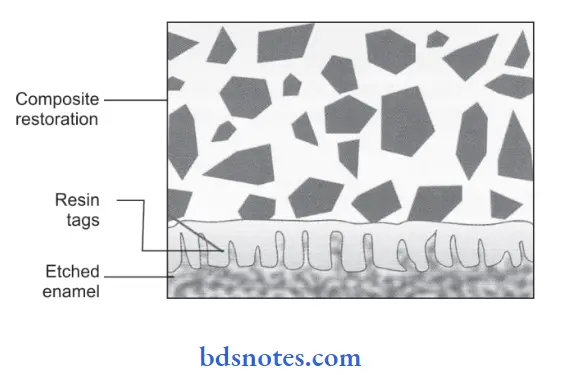
Used of Acid-etching: 37% phosphoric acid is used for etching.
Types of Acid-etching:
- Liquid etchants
- Gel etchants
The Technique of Application for Liquid Etchants:
Liquid etchants are used primarily to etch large surface areas of enamel, such as for veneers or sealants.
- Common types of applicators include small cotton pellets, foam sponges, and brushes.
- Gently apply the acid to the appropriate enamel surfaces to be restored, keeping the excess to a maximum of 0.5 mm past the anticipated extent of restoration.
- For preparations involving the proximal area, a polyester strip is placed before acid-etching to prevent the etching of the adjacent tooth.
- The application of acid is repeated every 10-15 seconds to keep the area moist for 30 seconds.
- A shorter etching time is advised as it yields acceptable bond strength in most cases and it also conserves enamel and saves time.
Care is to be taken not to flood the area with acid or to rub the enamel
- The acid is rinsed of thoroughly with a stream of water for 10-15 seconds after etching the tooth.
- If cotton roles were used for isolation, it should be replaced at this time, ensuring that the cavity preparation does not become contaminated with saliva.
- Now this tooth surface is dried with clean air for 20 seconds.
- Enamel that has been properly air-dried is described as having a ground glass or white frosted appearance.
The Technique of Application for Gel Etchants:
- For the application of a gel etchant, a brush paper point instrument or syringe are used to place the etchant onto the prepared enamel.
- Leave the surface untouched for 30 seconds after the application etchant.
- Rinse for 20 to 30 seconds with water.
- Dry the tooth surface.
Leave a Reply