Abnormal Hemoglobin
Question 1. Describe about abnormal haemoglobin.
Answer:
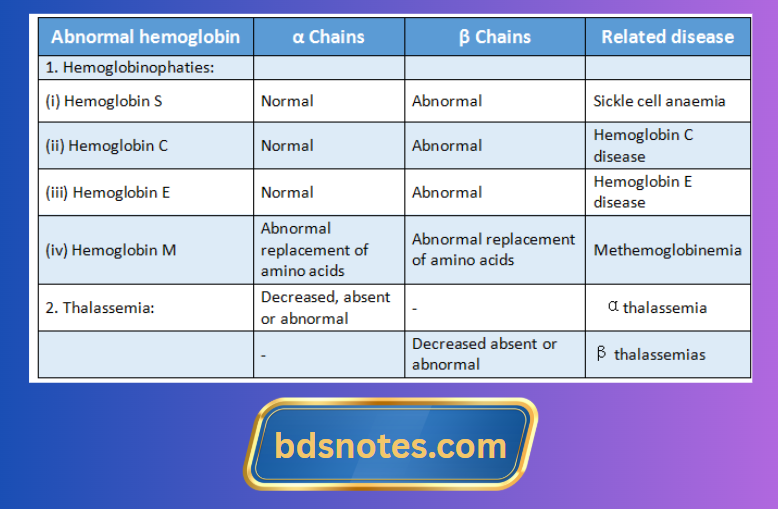
Abnormal haemoglobin:
- It is producted because of genetic mutation.
- This result is structural variations of polypeptide chains (α and β)
Question 2. Describe about abnormal haemoglobin derivatives.
Answer:
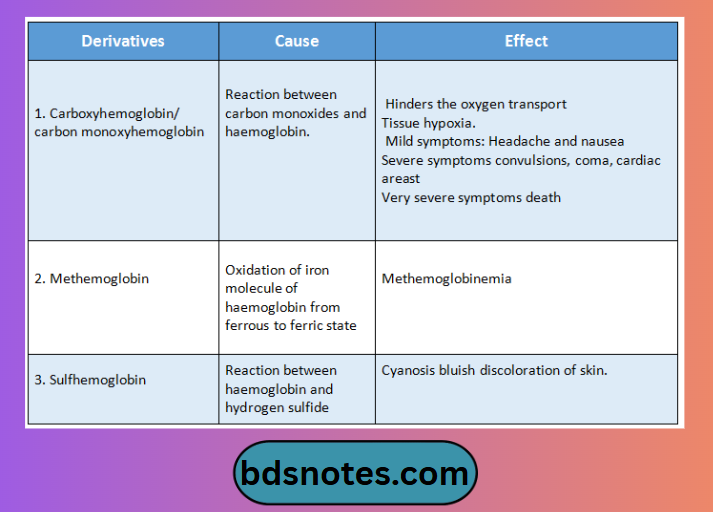
Abnormal haemoglobin derivaties:
- The abnormal haemoglobin derivaties in blood prevent the oxygen transport in tissues which results in severe hypoxia which may be fatal.
Question 3. Erythrocyte sedimentation rate.
Answer:
Erythrocyte sedimentation rate:
- It was first demonstrated by Edmund Biernacki in 1897.
Erythrocyte sedimentation rate Definition:
- The rate at which the erythrocytes gets settle down in a vertical tube is called erythrocyte sedimentation rate.
Erythrocyte sedimentation rate Determination:
1. By Westergren’s method:
- 1.6 ml of blood is mixed with 0.4ml of 3.8% sodium citrate.
- This is loaded is westergren’s tube which is kept vertically undisturbed for 1 hour.
- Reading is taken at the end of 1 hour.
2. By Wintrob’es method:
- About 1 ml of blood is mixed with EDTA O mark and kept undisturbed for 1 hour.
- Reading is taken after 1 hour.
Erythrocyte sedimentation rate Normal values:
- According to Westergren’s method:
- Males 3-7 mm in 1 hour
- Females59 mm in 1 hour
- Infants 0-2 mm in 1 hour.
Erythrocyte sedimentation rate Significance:
- ESR helps to confirm the diagnosis.
- It is helpful in assessing the patients response treated for certain chronic inflammatory disease.
Factors effecting ESR:
- Specific gravity of RBC.
- Rouleaux formation.
- Size of RBC
- Viscosity of blood.
- RBC count.
Leave a Reply