A Complete Guide To The Primary Mandibular Second Molar
Describe in detail about Primary Mandibular Second Molar.
Answer:
Primary Mandibular Second Molar Buccal aspect:
- It is wider at the cervical portion.
- Mesiobuccal and distobuccal developmental grooves divide the buccal surface into mesiobuccal, buccal, and distobuccal cusp.
- Roots appear slender and long.
- Roots flare mesiodistally at the middle and apical third.
- The point of bifurcation of the roots is just below the CEJ.
Primary Mandibular Second Molar Lingual aspect:
- Two equal cusps with a lingual groove between them are seen.
- The cervical line is relatively straight.
- A portion of each of the three buccal cusps may be seen. Roots appear slender and long.
Primary Mandibular Second Molar Mesial aspects:
- The tooth seems constricted occlusal. The lingual cusp is longer.
- The cervical line is regular.
- The mesial root is broad and flat.
Primary Mandibular Second Molar Distal aspect:
- Mesiobuccal and distobuccal cusps are seen distolingual cusp appears well developed.
- The triangular ridge extends from the distolingual cusp tip to the distal marginal ridge.
- The cervical line of the crown is regular.
- The distal root is broad and flat and tapers more at the apical end.
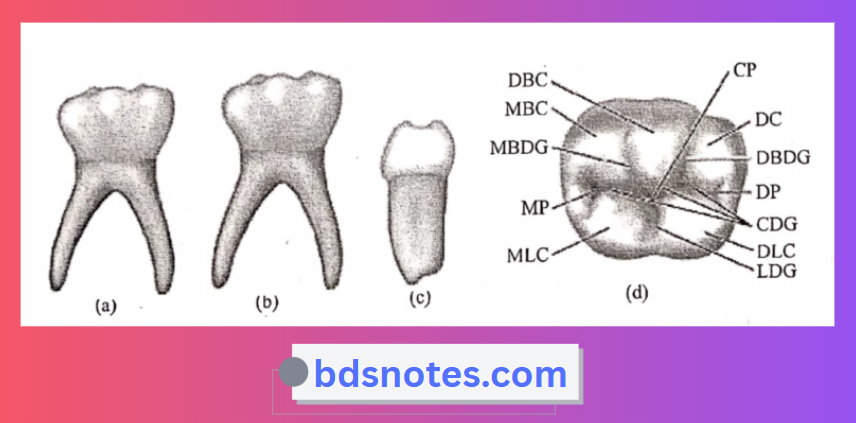
Primary Mandibular Second Molar Occlusal aspect:
- It is somewhat rectangular.
- Buccal cusps are the same in size, while both lingual cusps are equal.
- Well-defined triangular ridges are seen.
- The occlusal surface shows.
- Mesial triangular fossa.
- Inside the mesial marginal ridge.
- Distal triangular fossa.
- Mesial to the distal marginal ridge.
- Central developmental groove.
- Extends from mesial triangular fossa to distal triangular fossa.
- Two buccal grooves-mesial and distal.
- Lingual developmental groove.
- Supplemental grooves.
- Seen over slopes of triangular ridges and in mesial and distal triangular fossae.
- The mesial marginal ridge is well developed.
- Crown converge distally.
Leave a Reply