Occupational Hazards In Dentistry
Question 1. Write, short note on oral manifestations of AIDS.
Answer.
Oral manifestations of AIDS
Group 1: Strongly Associated with HIV Infection
- Candidiasis: Erythematous, pseudomembranous, angular cheilitis
- Hairy leukoplakia
- Kaposi’s sarcoma
- Non-Hodgkin lymphoma
- Periodontal diseases: Linear gingival erythema, necrotizing gingivitis, necrotizing periodontitis.
“Importance of addressing occupational hazards in dentistry”
Group 2: Less Commonly Associated with HIV Infection
- Bacterial infections: Mycobacterium avium-intracellulare, Mycobacterium tuberculosis
- Melanotic hyperpigmentation
- Necrotizing ulcerative stomatitis
- Salivary gland disease: Dry mouth, unilateral or bilateral swelling of major salivary glands
- Thrombocytopenia purpura
- Oral ulcerations NOS (not otherwise specified)
- Viral infections: Herpes simplex, human papillomavirus, varicella—zoster
Read And Learn More: Public Health Dentistry Question And Answers
“Common types of occupational hazards in dental settings explained”
Group 3: Seen in HIV Infection
- Bacterial infections: Actinomyces israelii, Escherichia coli, Klebsiella, Pneumonia
- Cat-scratch disease (Bartonella henselae)
- Epithelioid (bacillary) angiomatosis (Bartonella henselae)
- Drug reactions: Ulcerative, erythema multiforme, lichenoid, toxic epidermolysis
- Fungal infections other than candidiasis: Cryptococcus neoformans, Geotrichum candidum, Histoplasma capsulatum, Mucoraceae (mucormycosis/zygomycosis), Aspergillus flavus
- Neurologic disturbances: Facial palsy, trigeminal neuralgia
- Recurrent aphthous stomatitis
- Viral infections: Cytomegalovirus, Molluscum contagiosum
“Treatment options for addressing occupational injuries”
Question 2. Write a short note on prevention of AIDS.
Or
Write a short note on AIDS control in dentistry.
Answer. Following are the measures taken to prevent the AIDS:
- Someone can eliminate or reduce their risk of becoming infected with HIV during sex by choosing to:
- Abstain from sex or delay first sex – Be faithful to one partner or have fewer partners
- Condomize which means using male or female condoms consistently and correctly.
- There is a number of effective ways to encourage the people to adopt safer sexual behavior including media campaigns, social marketing, peer education and small group counseling.
- Comprehensive sex education for young people is an essential part of HIV prevention.
- Needle exchange programs have been shown to reduce the number of new HIV infections without encouraging drug use. These programs distribute clean needles and safely dispose of used ones.
- Healthcare workers themselves run a risk of HIV infection through contact with infected blood. The most effective way for staff to limit this risk is to practice universal precautions.
- HIV can be transmitted from a mother to her baby during pregnancy, labor and delivery, and later through breastfeeding. The first step towards reducing the number of babies infected in this way is to prevent HIV infection in women, and to prevent unwanted pregnancies.
“Role of ergonomics training in preventing workplace hazards”
Question 3. Write short note on occupational hazards in dentistry.
Answer. Occupational health aims at the promotion and the maintenance of the highest degree of physical, mental and social well-being of the workers in all occupations.
Any worker may be exposed to five types of hazards the depending upon the occupation:
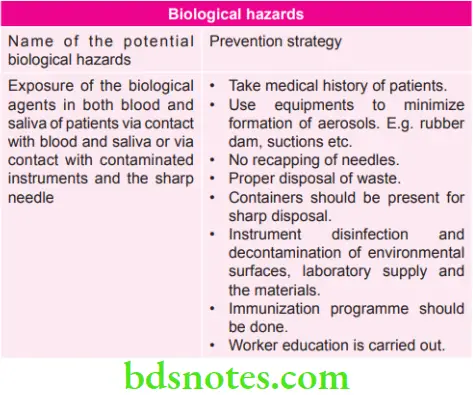
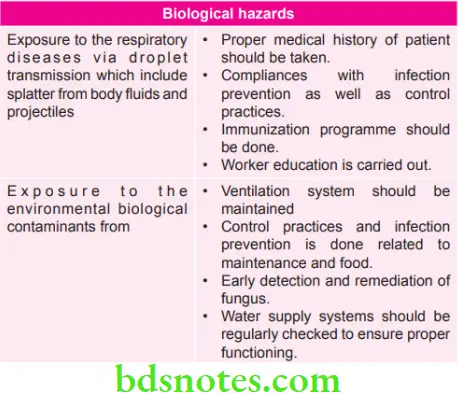
- Biological hazard
- Psychosocial hazard.
Occupational hazards in dentistry:
“Pathophysiology of occupational hazards in dentistry explained”
“Techniques for managing stress caused by occupational risks”
Question 4. Write a short note on the prevention of radiation in the dental office.
Answer.
The following are the preventive strategies for the protection from radiation in a dental office:
- The workplace should be designed such that there is a distance between the worker and the source.
- Shielding materials should be placed at appropriate places.
- Equipment should be designed to minimize the scatter.
- Positioning devices should be used for the patients.
- Audible signs should be placed in machines so that one can know that exposure is stopped.
- Older dental X-ray equipment should be replaced by newer equipment for additional safety.
- Technicians should be educated for the prevention of radiation.
Leave a Reply