Introduction To Dentistry
Question 1. Write a short note on the objectives of community dentistry.
Answer.
Objectives of Community Dentistry
Knowledge and Understanding
- There should be adequate knowledge of scientificfoundation as well as good understanding of scientific methods which are to be carried out. One should able to evaluate scientifically established facts and data.
- There should be adequate knowledge of growth, structure and the function of teeth and oral cavity as well as the associated tissues in health and disease and their relationship over general state of health and on physical and social wellbeing of the patient.
- There should be adequate knowledge of clinical methods which give the correlation to anomalies, lesions and diseases of teeth and oral cavity as well as preventive, diagnostic and therapeutic aspects of dentistry.
- There should be adequate clinical experience required for dental practice.
- There should be adequate knowledge of the behavior of persons in sickness and health.
“Understanding dental anatomy: Basics and applications”

Skills
- One should be able to diagnose as well as manage common dental problems that occur in dental practice. It has to be kept in mind that society has the right to receive best possible treatment.
- While carrying out various dental surgical procedures, one should be skilled to prevent as well as manage the complications.
- One should have proper skills for carrying out investigative procedures and have a good ability to interpret laboratory values.
- Competency should be there while controlling pain and anxiety during dental procedures.
Attitude
- Current knowledge of dentistry should be applied in the best interest of patients and the community.
- Professional ethics and conduct should be maintained well.
- Awareness should be improved, and possible solutions are provided for oral health problems in the community.
- Knowledge and professional skills are updated from time to time, and one should willingly participate in the continuing dental programs.
- One should help and participate in the implementation of National Health Programs.
Read And Learn More: Public Health Dentistry Question And Answers
Question 2. What are the objectives of public health dentistry? Discuss in detail how consideration for community dentistry differs from conventional practice.
Or
Write the differences between individual practice and community practice.
Answer.
Difference Between Community Dentistry and Private Dental Practice
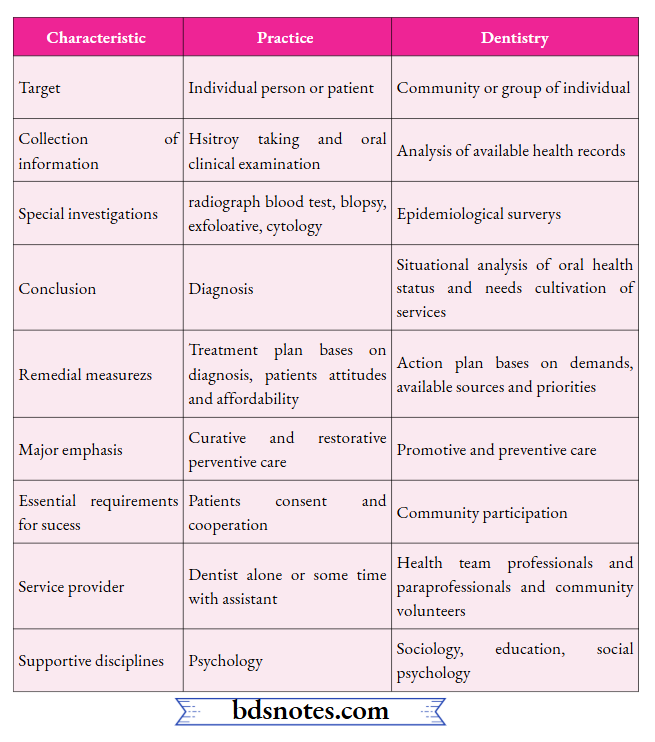
“Importance of learning dental anatomy for dentists”
Question 3. Define community dentistry. Write the aims and objectives of community dentistry. Discuss the differences between community dentistry and private dental practice.
Answer: Definition of Community Dentistry
Community dentistry is defined as “The science and art of preventing and controlling dental diseases and promoting dental health through organized community efforts. It is that form of dental practice which serves the community as a patient rather than an individual.
It is concerned with the dental health education of the public with applied dental research and with the administration or group dental care programs, as well as the prevention and control of dental diseases on a community basis.
Aims of Community Dentistry
Federation dentaire internationale (FDI) aims related to community dentistry were adopted by the general assembly in 2001, Kuala Lumpur, Malaysia.
The following are the aims of community dentistry:
- To develop support and promote programs which are aimed at the prevention of oral diseases and the improvement of general and oral health.
- To provide expertise and advice on an oral health promotion program suitable for various situations.
- To develop collaboration with member associations, intergovernmental, governmental, and voluntary organizations involved in the promotion of general and oral health.
- To promote the delivery of the best possible oral health care.
- To provide a world forum to exchange knowledge and experience in all aspects of oral health and oral health care.
- To analyze trends and development of importance to oral health and oral health care worldwide.
- To develop, adopt, and encourage proactive programs to progressively develop oral health care worldwide.
- To provide a comprehensive information and communication system for making relevant information available to members, media, and the government.
Question 4. Write briefly on the Indian Dental Association.
Or
Write a short note on the Indian Dental Association.
Or
Write a short note on the IDA.
Or
Describe briefly the IDA.
Answer: The Indian Dental Association (IDA) was formed in the year 1949 soon after the dentist act 1948 was passed in the Indian Parliament, before which, it was known as the All Indian Dental Association. The association was registered in Delhi in 1947 with register number, S/265.
Objectives of IDA
- Promotion, encouragement, and advancement of dental and allied sciences.
- To encourage the members to undertake measures for the improvement of public health and education in India.
- Maintenance of honor and dignity and the upholding of interest of the dental profession and cooperation between the members of the same profession.
Structure of IDA
- IDA has its registered office in India, where the Honorary General Secretary resides.
- Branches of IDA are spread all over India, but it consists of two types of branches, i.e.
- Local branches: Situated at the district headquarters or other places in the district.
- State branches: These branches have headquarters in their states and consist of local branches in the state as their units.
- Local branches of IDA have a minimum of 30 life members.
- There should not be more than one branch in a town.
“Common terms used in dental anatomy explained”
Membership of IDA
Dentists who are registered under the Indian Dentist Act, 1948, become members of the association.
Following Are the Categories of IDA Members
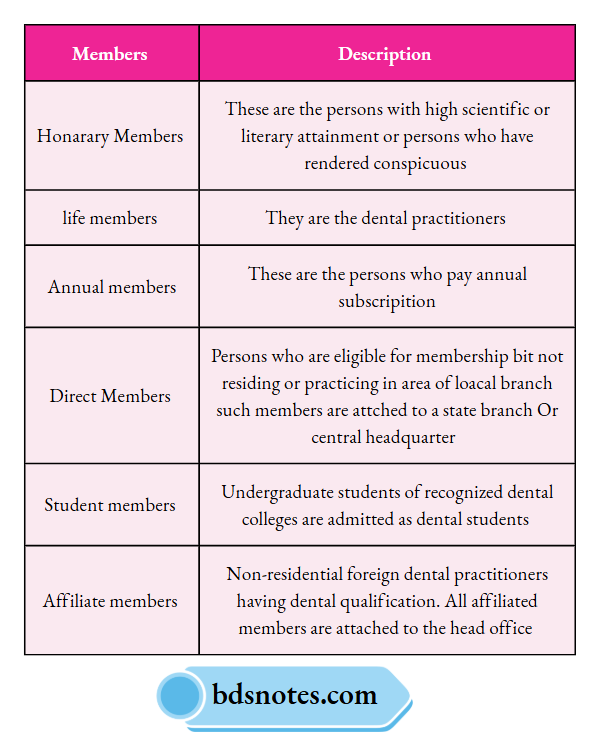
“Emerging research on advanced dental anatomy techniques”
Privileges of Membership of IDA
- All members should get a journal and any other publication of the association, which is free of cost.
- All members should use the library and Association rooms, if present.
- All members have the right to attend discussions in all general meetings, lectures, and conferences organized by the Association.
- All members should enjoy other privileges that may be given by the central council.
Functions of the IDA
- Holding the meetings and conferences of the members of the Association and the dental profession in general.
- Publishing and circulating a journal which is the official organ of the association, of a character which is specially adapted to the needs of the dental profession in India, and which shall also take publicity and propaganda of the work of the association through its columns.
- Encouraging the opening of libraries in branches and buying books from the fund of association.
- Publishing the papers from time to time related to dental research, which are conducted by members independently or under the auspices ofthe association.
- By conducting the educational campaign among the masses of India in the matter of oral hygiene by cooperating with different public bodies working with the same objectives.
- Encourage research in dental and allied sciences with grants out of funds of the association, by establishing scholarships and maintaining international contacts with the foreign dental associations.
- Also, to express the views on all the questions which are about the Indian legislation that affect public health, the dental profession, and dental education, and take such steps from time to time regarding the same as shall be deemed expedient or necessary. And finally, to do all the other things that are cognate to the objectives of the association, or are incidental, or are conducive to the attainment of the above-given objectives.
- Protects the public from unethical treatment by unqualified practitioners.
- Trying to set the exemption from customs duty for essential materials and instruments.
“Signs of abnormal tooth morphology in dental anatomy”
Question 5. Write a short note on the importance and functions of IDA.
Or
Write a short note on the functions of IDA.
Answer.
Importance of IDA
- It promotes, encourages, and advances dental and allied sciences.
- It encourages the member to undertake measures for the improvement of public health and education in India.
- It maintains honor and dignity and the upholding of interest of the dental profession and cooperation among the members of same profession.
- It protects the rights and interests of members of the Association.
“Pathophysiology of dental anatomy issues explained”
Question 6. Write a short note on the Dentist’s Act.
Answer. The Dentist Act, 1948, is an Act to regulate the profession of dentistry.
It was introduced on 29th March, 1948.
- It extends to the whole of India.
- The Act contains five chapters with their sub-sections:
- Chapter 1: Introduction
- Chapter 2: Dental Council of India
- Chapter 3: State Dental Councils
- Chapter 4: Registration
- Chapter 5: Miscellaneous.
- It was an Act to uphold the prestige, dignity, and honor of the dental profession.
- Before 1948, dentistry was practiced by an unqualified person.
- In 1948, the Indian Government formulates a Dental act stating that only qualified graduates should deliver dental care and they were place in part A registration of the Dental Council.
- To fulfil the objectives of the Dental Act, the Dental Council of India (DCI) was formulated.
The Dentists (Amendment) Act came into force on the 27th day of August 1992. In these various sections were inserted after section 10 of the Dentist’s Act 1948.
“Techniques for managing occlusion problems”
Question 7. Write a short note on the Dental Council of India.
Or
Write a short note on the DCI.
Or
Write briefly on the Dental Council of India.
Or
Write a short answer on the DCI.
Answer. The Dental Council of India (DCI) was formed on 12th April, 1949.
Duties or Objectives of the DCI
- DCI should maintain uniform standards of dental education, both at the undergraduate and postgraduate levels.
- It should provide standard curriculum for training of dentists, dental hygienists, dental mechanics and conditions for such training.
- It should prescribe the standard of examinations and other requirements to be satisfied to secure a qualification recognized under the Dentists’ Act.
Composition of the DCI
As per the Dentist Act, 1948 the representatives of following group contribute to composition of the Dental Council of India.
- One registered dentist which possess a recognized dental qualification elected by the dentists registered in part A of each state register.
- One member was registered by members of the Medical Council of India (MCI).
- Not more than four members elected among themselves by:
- Principal, Dean, Director, and Vice Principal of dental colleges in states that train students for recognized dental qualifications, given that not more than one member is elected from the same dental college.
- Dental wing heads of medical colleges in states who train dental students for a recognized dental qualification.
- One member from each university established by the law in the state that grants a recognized dental qualification is elected by members of the senate of the university.
- One member to represent one state, nominated by government of each such state from among persons registered either in medical register or in dental register of the state.
- Six members nominated by the Central Government, of whom at least one shall be a registered dentist possessing a recognized dental qualification and practicing or holding an appointment in an institution for training of dentists in four union territories, and at least two shall be dentists registered in Part B of the state register.
- The Director General of Health Services, ex officio.
“Role of cusps and ridges in tooth function”
Question 8. Write a short note on the functions of DCI.
Or
Write a short answer on the functions of DCI.
Answer: The following are the functions of DCI:
- Check the minimum education standard for the BDS degree.
- Check the minimum physical requirements of a dental college.
- Check the minimum staff pattern for undergraduate dental studies in college with 40, 60, and 100 admissions.
- Basic qualifications and teaching experience are required to teach BDS and MDS students.
- General establishment of dental facilities, their duration, and selection of students.
- Migration and transfer rules for MDS.
- Regulation ofthe scheme of exam for BDS and MDS.
- Dental curriculum: Time and subject specification for clinical program and field program, syllabus, etc.
“Treatment options based on dental anatomy findings”
Question 9. Write notes on modalities of constitution and composition of the Dental Council of India.
Answer: The following are the modalities of constitution and composition of the Dental Council of India:
Central Government shall, as soon as may be, constitute a council consisting of the following members, namely:
- One registered dentist possessing a recognized dental qualification elected by the dentists registered in Part A of each state register;
- One member is elected from amongst themselves by the members of the Medical Council of India.
- Not more than four members elected from among themselves by
- Principals, deans, directors, and vice principals of dental colleges in the states training students for recognized dental qualifications, provided that not more than one member shall be elected from the same dental college.
- Heads of dental wings of medical colleges in the United States are training students for recognized dental qualifications.
- One member from each university established by the law in the states which grants a recognized dental qualification, to be elected by the members of the senate of the university or in case the university has no senate, by the members of the court, from amongst the members of the dental faculty of the university or in case the university has no dental faculty, from amongst the members of the medical faculty thereof;
- One member to represent one state, nominated by the government of each such state from among persons registered either in a medical register or a dental register of the state; (Explanation: In this clause, “State” does not include a Union Territory)
- Six members nominated by the Central government, of whom at least one shall be a registered dentist possessing a recognized dental qualification and practicing or holding an appointment in an institution for the training of dentists in four Union territories, and at least two shall be dentists registered in Part B of a state register;
- The Director-General of health services, ex-officio; Provided that pending the preparation of registers the state governments may nominate to the first council members referred to in parts (A) and (E) and the central government members referred to in part (F) out of persons who are eligible for registration in the respective registers and such persons shall hold office for such period as the state or Central Government may, by notification in the official gazette, specify.
Leave a Reply