Periodontal Abscess
Describe sign and symptoms of acute periodontal abscess. How will you differentiate between acute periodontal abscess and acute periapical abscess.
Or
Write short note on treatment of acute periodontal abscess.
Or
What is periodontal abscess? Give clinical features and treatment of acute periodontal abscess.
Or
Write differences between periodontal abscess and periapical abscess.
Answer. Periodontal abscess is defined as a suppurative lesion associated with periodontal breakdown and localized accumulation of pus within a gingival wall of periodontal pocket.
Acute Periodontal Abscess Clinical Features
Signs of Acute Periodontal Abscess
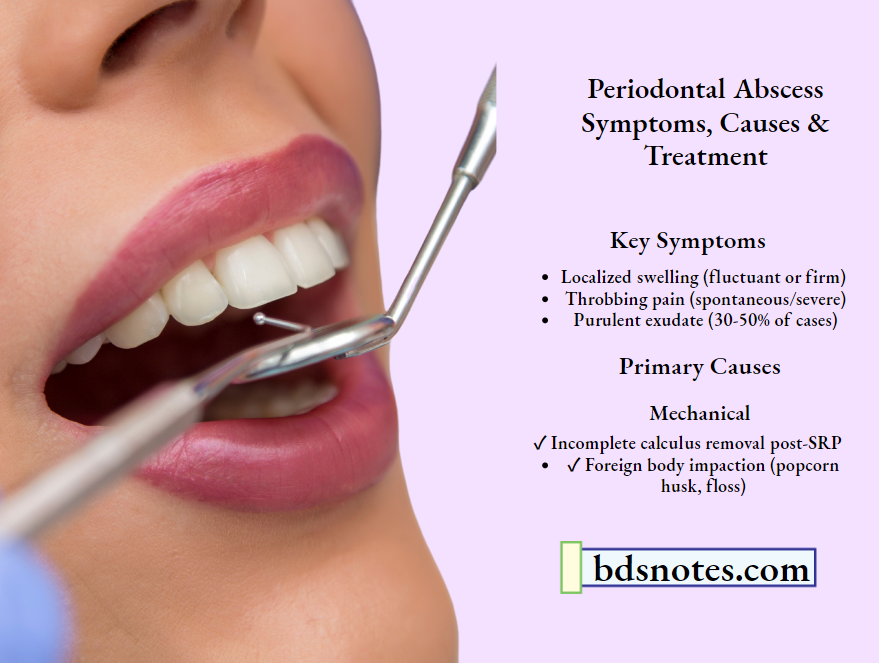
- Acute Periodontal Abscess appears as an ovoid elevation of gingiva along the lateral aspect of root.
- Gingiva is edematous and red, with smooth shiny surface.
- Area may be dome like and relatively firm or pointed and soft.
- In most cases, pus is expressed from the gingival margin with gentle digital pressure.
“Importance of studying periodontal abscess for dental professionals”
- Sensitivity is present to percussion of offending tooth.
- Bleeding on probing is present.
- Pinpoint orifice of sinus may be present. Sinus is usually enclosed with small, pink, bead-like mass of granulation tissue.
“Understanding the role of bacteria in periodontal abscess formation”
“Common challenges in diagnosing and treating periodontal abscesses”
Read And Learn More: Periodontics Question And Answers
Symptoms of Acute Periodontal Abscess
- There is an acute episode usually has sudden onset with extreme onset.
- Tooth elevation and mobility is seen.
- Pain is localized and patient can identify the offending teeth.
- Pain is throbbing and radiating in nature.
- Fever, leukocytosis and malaise are present.
“Signs of a periodontal abscess in early stages”
Acute Periodontal Abscess Treatment
- As the condition is a dental emergency. Patient should be treated as soon as possible to relieve pain and resolve the infection.
- Various treatment modalities are:
- Drainage through pocket retraction or incision.
- Scaling and root planning
- Periodontal surgery
- Systemic antibiotics
- Extraction of tooth
- Treatment should be carried out in two stages, i.e. management of acute lesion and proper treatment of residual lesion as acute condition come under control.
- Primary treatment for relief of acute symptoms is incision and drainage.
“Role of swelling and pain in diagnosing periodontal abscesses”
Procedure for Incision and Drainage
- Anesthetize the area and a probe is carefully introduced in pocket in an attempt to distend the pocket wall.
- Now a small curette then gently used to penetrate tissues and establish the drainage. Root surface is then thoroughly planed to eliminate plaque and calculus.
- When drainage is not easily established or when abscess is seen pointing via the gingiva an external incision is given.
- Take a no.11 Bard–Parker blade, a vertical incision is given at the highest point of fluctuation.
“Early warning signs of untreated periodontal infections”
- As initial extravasation of blood and pus is over, area is irrigated by antiseptic agent and incision is gently spread to facilitate the drainage.
- As procedure gets completed, patient is instructed to rinse with warm saline and is examined after 24 to 48 hours.
- Systemic antibiotics, i.e. amoxicillin and metronidazole are given to the patient.
- Another treatment for new attachment and new tissue regeneration may be performed.
- If roots are denuded beyond the apical third of root, tooth is extracted and curettage is done to remove granulation tissue from pocket.
Difference between Acute Periodontal Abscess and Acute Periapical Abscess
“Asymptomatic vs symptomatic effects of delayed diagnosis”

Leave a Reply