Adenomatoid Odontogenic Tumor
Question. Write a short note on adenomatoid odontogenic tumor.
Answer.
Adenomatoid Odontogenic Tumor
It is also called adenoameloblastoma or ameloblastic adenomatoid tumor.
Adenomatoid odontogenic tumor is uncommon, well-circumscribed, odontogenic neoplasm characterized by the formation of multiple duct-like structures by neoplastic epithelial cells.
adenomatoid odontogenic tumor
“Importance of early diagnosis of adenomatoid odontogenic tumor”
Clinical Features Of Adenomatoid Odontogenic Tumor
- Tumor usually occurs at a younger age.
- Females are more commonly affected
- Lesions most typically appear in the maxillary anterior region.
- Tumor presents a slow-enlarging, small, bony, hard swelling in the maxillary anterior region.
- Sometimes, it occurs in the premolar region
- There is displacement of regional teeth, mild pain, and expansion of cortical bones.
“Common features of adenomatoid odontogenic tumor explained”
Histopathology Of Adenomatoid Odontogenic Tumor
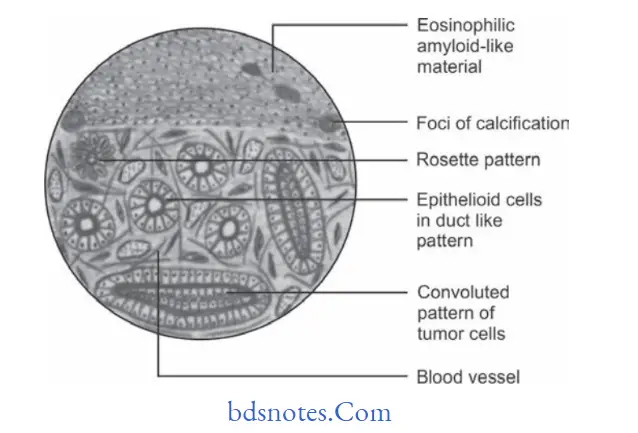
- Microscopically, adenoid odontogenic tumor reveals neoplastic odontogenic epithelial cells, proliferating in multiple “duct-like” patterns.
- The presence of these duct-like structures often gives a glandular lesion.
- Each duct-like structure is bordered on the periphery by a single layer of tall columnar cells that resemble ameloblastoma.
Odontogenic Tumors Quiz Questions
- Lumen of duct-like structures is filled with the homogenous eosinophilic coagulum.
- Small foci of calcifications are often seen, which are scattered throughout the lesion.
- Droplets of amorphous (PAS-positive) eosinophilic material are found between neoplastic cells.
odontogenic tumor types
“Treatment options for adenomatoid odontogenic tumor”
“Role of CBCT in diagnosing adenomatoid odontogenic tumors”
Differential Diagnosis Of Adenomatoid Odontogenic Tumor
- Dentigerous cyst
- Odontomes
- Unicystic ameloblastoma
- CEOT
- CEOC.
Treatment of Adenomatoid Odontogenic Tumor
The treatment is surgical enucleation.
Leave a Reply