Mucosal Candidiasis Clinical Presentation
Question. Write a short note on acute pseudomembranous candidiasis.
Or
Write a short note on oral thrush.
“Understanding the clinical presentation of mucosal candidiasis: Q&A explained”
Answer. It is commonly known as “oral thrush”.
- Acute pseudomembranous candidiasis appears as a smooth, thick, creamywhite or allow, soft and friable plaque on the oral mucosa.
- Plaque can be easily wiped of by gentle scraping, which leaves an erythematous, raw, bleeding surface in the underlying area.
- Lesions may occur at any mucosal site and vary in size ranging from small areas to confluent plaques.
- Plaque consists of fungal organisms, keratotic debris, inflammatory cells, desquamated epithelial cells, and firin, etc.
- Oral thrush commonly occurs among children, debilitated elderly persons and AIDS patients.
“Importance of recognizing mucosal candidiasis clinical features: Questions explained”
Histopathology
- Hyperplastic epithelium with superficial necrotic and desquamating parakeratinized layer.
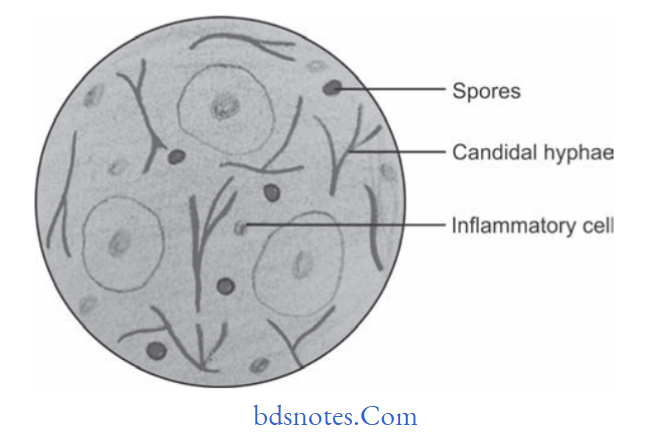
- Hyperplastic epithelium is infiltrated by candidal hyphae and yeast cells along with PMNs.
- Often, there is a separation between the superficial pseudomembrane and the deeper layers of epithelium.
- Candidal hyphae often appear as a weakly basophilic, thread-like structures.
- Lamina propria is infiltrated by chronic inflammatory cells,i.e., lymphocytes and plasma cells.
“Common challenges in diagnosing mucosal candidiasis effectively: FAQs provided”
“Steps to explain causes of mucosal candidiasis: Candida albicans vs immune suppression: Q&A guide”
Treatment
- Antifungal drugs, i.e., nystatin, amphotericinB should be given.
- Proper oral hygiene should be maintained.
Leave a Reply