• Skip to main content
  • Skip to secondary menu
  • Skip to primary sidebar
  • About Us
  • Terms of Use
  • Privacy Policy
  • Disclaimer
  • Contact Us
  • Sitemap

BDS Notes

BDS notes, Question and Answers

  • Public Health Dentistry
  • Periodontics
  • Pharmacology
  • Pathology
  • Orthodontics
    • Anchorage In Orthodontics
    • Mandibular Growth, Functional Matrix
    • Retention and Relapse
  • General Surgery
    • Cysts: Types, Causes, Symptoms
    • Maxillofacial Fractures, Disorders, and Treatments
    • Lymphatic Disorders
    • Neurological and Facial Disorders
  • Temporal And Infratemporal Regions
    • Spinal and Neuroanatomy
  • Dental Materials
    • Dental Amalgam
Home » Antiamoebic Drugs

Antiamoebic Drugs

October 17, 2025 by Kristensmith Taylor Leave a Comment

Antiamoebic Drugs

Write In Brief About Antiamoebic Drugs And Their Significance In Dental Pharmacology.
Answer:

Antiamoebic drugs are those which are used to treat amoebiasis caused by the protozoan known as entamoeba histolytica.

Classification Of Antiamoebic Drugs

1. Tissue amoebicides

  • For both intestinal and extraintestinal amoebiasis:
    • Nitroimidazoles, i.e. metronidazole, tinidazole, Secnidazole
    • Alkaloids: Emetine, dehydroemetine.
  • For extraintestinal amoebiasis, i.e. chloroquine.

Antiamoebic Drugs: Types, Mechanism of Action, and Uses

2. Luminal amoebicides

  • Amide: Diloxamide furoate, nitazoxanide
  • 8-hydroxyquinolines, i.e. quiniodochlor, diiodohydroxyquin
  • Antibiotics: Tetracyclines.

Antiamoebic Drugs In Brief
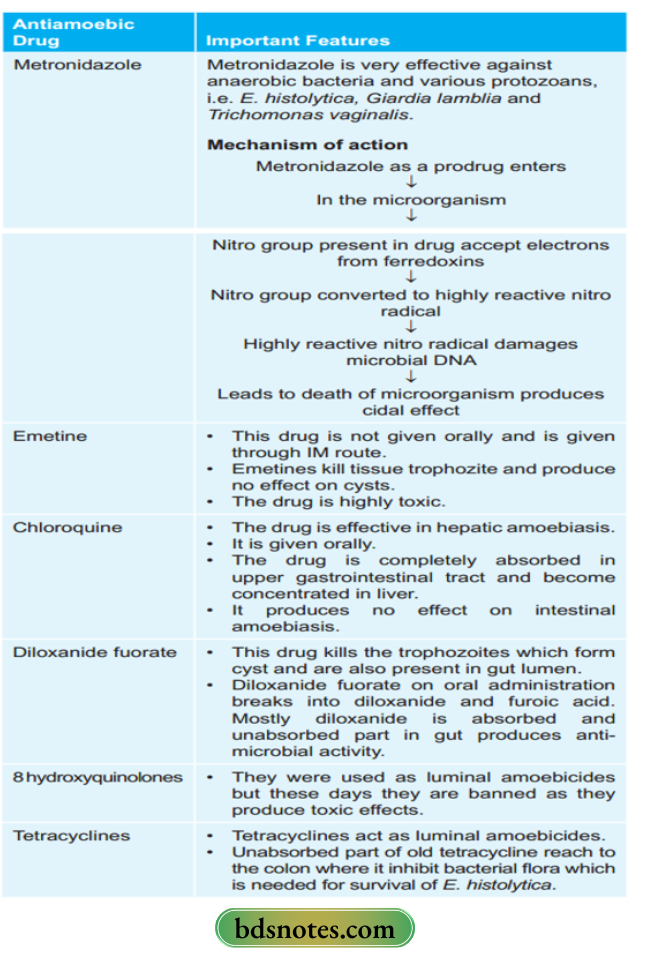
Antiamoebic Drugs In Brief

Significance Of Antiamoebic Drugs In Dental Pharmacology

  • Metronidazole is used in the treatment of alveolar abscesses, pericoronitis, periodontitis, etc.
  • Metronidazole is used in acute ulcerative gingivitis. It is given as 200 to 400 mg for a week.
  • Tinidazole is used in oriental anaerobic infections. It is given as 600 mg BD for 5 days.
  • Tetracyclines are mainly used in chronic periodontitis. They are also used in the treatment of acute necrotizing ulcerative gingivitis.

Filed Under: Pharmacology

Reader Interactions

Leave a Reply Cancel reply

Your email address will not be published. Required fields are marked *

Primary Sidebar

Recent Posts

  • Branchial Cleft Cyst: Background, Pathophysiology, Etiology
  • Maxillary Nerve: Origin, Course, And Branches
  • The Father Of Anatomy And A Great Anatomist Herophilus
  • Bone Structure – Anatomy
  • The External Carotid Artery: Anatomy, Branches, And Functions
  • Occipitofrontalis Muscle
  • Superficial Temporal Artery
  • Platysma Muscle
  • Cartilage
  • Cauda Equina And Conus Medullaris Syndromes
  • Subcutaneous Injections And Device Management
  • Types Of Circulation: Pulmonary, Systemic, And Portal
  • Structure Of Skeletal Muscle
  • Elastic Cartilage
  • Cellular Organelles And Structure
  • The Golgi Apparatus – The Cell
  • The Cytoplasmic Inclusions Of Certain Plant Cells
  • Dental Abscess
  • Laser Surgery
  • Our Facial Muscles And Their Functions

Copyright © 2026 · Magazine Pro on Genesis Framework · WordPress · Log in